
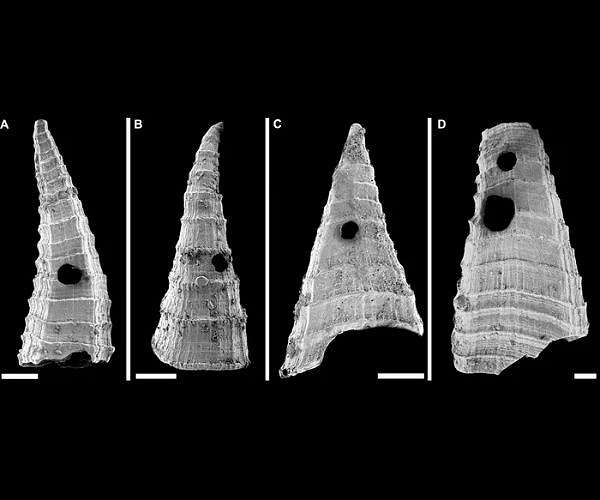
A groundbreaking study by researchers at the American Museum of Natural History has revealed the oldest known example of an evolutionary arms race in the fossil record. The findings, published in Current Biology, document predator-prey interactions from 517 million years ago during the Cambrian period, in what is now South Australia. The study highlights the interplay between a small shelled creature distantly related to brachiopods and an unidentified predator capable of penetrating its shell.
"Predator-prey interactions are often touted as a major driver of the Cambrian explosion, especially with regard to the rapid increase in diversity and abundance of biomineralizing organisms at this time. Yet, there has been a paucity of empirical evidence showing that prey directly responded to predation, and vice versa," explained Russell Bicknell, a postdoctoral researcher in the Museum's Division of Paleontology and the lead author of the study.
An evolutionary arms race describes the reciprocal adaptations between predators and prey. As predators evolve methods to capture prey, the prey evolves defenses in response, creating a dynamic cycle of adaptation.
Bicknell, alongside colleagues from the University of New England and Macquarie University in Australia, analyzed over 200 fossilized shells of the Cambrian species Lapworthella fasciculata. These fossils, collected from South Australia, revealed holes likely created by a soft-bodied mollusk or worm capable of piercing the shells. By examining the fossils' geological ages, the researchers noted a simultaneous increase in shell wall thickness and perforation marks, suggesting a microevolutionary response. The prey species likely evolved thicker shells to deter predators, while predators adapted their methods to overcome these defenses.
"This critically important evolutionary record demonstrates, for the first time, that predation played a pivotal role in the proliferation of early animal ecosystems and shows the rapid speed at which such phenotypic modifications arose during the Cambrian Explosion event," Bicknell added.
This research provides key evidence that predator-prey dynamics were instrumental in driving evolutionary innovation during the Cambrian Explosion, a period characterized by an unprecedented surge in animal diversity and complexity.
Research Report:Adaptive responses in Cambrian predator and prey highlight the arms race during the rise of animals
