
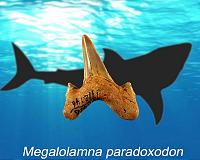
Analysis of ancient shark teeth, collected in Japan, Peru and the United States, has yielded a new extinct shark species named Megalolamna paradoxodon. Scientists described the species in a new study, published this week in the journal Historical Biology.
The new species belongs to the family of extinct sharks known as Otodontidae, a group that includes the famed megalodon. The teeth of Megalolamna paradoxodon recall those of other Otodontidae species, but they also resemble an enlarged version of the teeth of modern salmon shark from the genus Lamna.
For this reason, scientists were forced to create a new genus, Megalolamna, under which to classify the novel species.
The largest Megalolamna teeth measure roughly 1.8 inches in length, suggesting the ancient shark was the equivalent of a modern great white — approximately 13 feet long. The species boasted grasping teeth in the front of its mouth and slicing teeth in the back.
"It's quite remarkable that such a large lamniform shark with such a global distribution had evaded recognition until now, especially because there are numerous Miocene localities where fossil shark teeth are well sampled," Kenshu Shimada, a paleobiologist at DePaul University, said in a news release.
In addition to carving out a new genus for the species, researchers also reclassified the megatoothed lineage, moving megalodon and its closest relatives from their traditional genus of Carcharocles to a new home under the Otodus umbrella.
"The idea that megalodon and its close allies should be placed in Otodus is not new, but our study is the first of its kind that logically demonstrates the taxonomic proposition," Shimada explained.
