
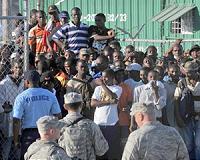
It's a dangerous game of cat and mouse: Haitians creep up to the bank of a river turned into a raging torrent by Hurricane Matthew, then scamper away.
The wind howls and rains falls in buckets. But people playfully ignore the firefighters and others who have come to evacuate them from their slice of the worst storm to hit the Caribbean in nearly a decade.
Rather, they laugh as the wind tosses them about and take cell phone pictures of nature's raw power.
And then they do it again: catch a glimpse of the wildly engorged river, and run away like children when the wind blasts them in the face.
"We came here to help evacuate them but they will not listen to us," said Edgar Joseph, a fireman, said Tuesday. "They are so stubborn."
Joseph said that as the water level was rising and the current flowing ever faster, it was just a matter of time before the Riviere Grise in Port-au-Prince bursts its banks.
Matthew made landfall early Tuesday near Haiti's southwestern tip, triggering major floods and evacuations. At least three people have died.
Port-au-Prince is not in the direct path of the storm. It lies far to the east, sitting on a bay that acts as a natural harbor. Still, the city has seen heavy rain since Monday evening.
The river bank is lined with shanties typical of the poorest country in the Americas: shacks made of sheet metal or plastic lining.
"There are lots of children, and the parents have to understand this: we want to save your lives and those of your children by taking you to safety in the nearby school," fireman Michelet Louis yelled to a group of adults he has managed to hold together in a group.
He tell them they have to get out. But they pay no attention.
Flooding has begun in and around Port-au-Prince, as the ground is so eroded it cannot absorb water and canals meant to be drainage conduits are clogged with garbage.
This is happening particularly in poor areas by the seaside.
— 'Crazy of me' —
Thony Meus, a 19 year old wearing plastic bags to try to cover his head and torso, trekked 10 kilometers (six miles) from the coast to the riverbank area to check up on his sister, who lives there.
The area is flat and floods easily, Meus said.
"I want to make sure she is OK," he said. "I am going to do everything I can to make sure she evacuates because things are going to get worse with time."
He adds: "But Haitians are stubborn. They only believe things when they see them."
Flood waters have started to cut off the road he needs to take. But Meus is hell-bent on reaching his sibling.
"I know this is crazy of me but I want to make sure my sister and her children are not in danger," he said, then trudges off, splashing water as he walks.
Coming along the same road in the other direction, a street vendor named Marcus Stevenson — he peddles canned meat — says he should have stayed home, too.
"I don't have a penny to my name, so I have no choice. I have to come out and work. Otherwise, I will starve."
Upon learning the weather will only get worse in Port-au-Prince, he gets nervous.
"I don't even know if I am going to make it back home now," Stevenson says. There are no customers in sight, anyway. The street is empty.
