
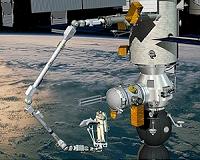
This week we celebrate 15 years of European astronauts on the International Space Station (ISS). And it has been quite the journey. Umberto Guidoni made history as the first European astronaut to board the ISS on 23rd April 2001, when he delivered elements and equipment required for the ongoing assembly of the ISS. Most notably, he delivered the Raffaello Multi-Purpose Logistics Module, which was provided by the Italian Space Agency. He also delivered the Space Station Remote Manipulator System. This was a Canadian robot arm that would be used to extensively build the station in the coming years.
16 further European astronauts have visited the ISS since Guidoni, with British astronaut Tim Peake currently serving a six-month-long duration mission. But how is it possible that the ISS has stayed serviceable for so long? The answer: specialist equipment to fix any problem. Here, we take a look at some of these features.
In Case of Medical Emergency: Keeping Astronauts Healthy
Thankfully, there's never been a major medical incident on the ISS. However, preventative measures are still in place in case a problem arises.
When Tim Peake was blasted into space last December, he was given 40 hours of medical training before he embarked, including training on how to stitch wound, how to give someone an injection and how to extract a tooth. NASA ensures that all astronauts are trained so they can deal with common medical problems, such as motion sickness, back pain, skin conditions and burns.
Astronauts also get specialist equipment, however, including a defibrillator, a portable ultrasound, a device for looking into the back of someone's eye and a litre of saline. However, in a medical emergency, the astronaut would have to fly back to earth in the Soyuz spacecraft which is docked to the ISS. It's calculated that the risk of a medical emergency occurring on the ISS is only 1-2%, but at least they're prepared in case the worst should happen.
Fixing the Station: Engineering in Space
Of course, a threat to life can also be apparent if there's an issue with the station itself. To prevent this, repair work is constantly undertaken. NASA regularly publishes status reports which show the work that astronauts are undertaking to keep the ISS running.
To do this, they have a number of pieces of specialist equipment on board, such as oscilloscopes, multimeters and current probes. These repair works are carried out in co-ordination with NASA on the ground. The astronauts help to guide ground teams who troubleshoot many of the problems through the use of controller cards.
Once a problem on the ISS has been solved, the data captured by the ground team is then analysed by the ground team to determine the fault. Then a course of action can be determined to fix the issue. This usually involves Robonaut, a humanoid robot designed with the versatility and dexterity to manipulate hardware and work in high risk environments that aren't safe for astronauts.
Since the ISS first launched, we've seen a great development in the way it's handled and cared for, with many European astronauts visiting. There's plenty of specialist equipment on board to help both the astronauts and the space station. Hopefully this will develop further to ensure astronauts are safer than ever before.
