
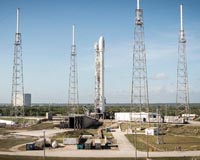
SpaceX on Thursday postponed the launch of an Asian communications satellite after detecting a "tiny glitch" in the Falcon 9 rocket engine, CEO Elon Musk said.
"There was a tiny glitch in the motion of an upper stage engine actuator," Musk said on Twitter.
"Probably not a flight risk but still worth investigating."
The next attempt at launching from Cape Canaveral, Florida will be Friday at the earliest, the head of the California-based company said without specifying a time.
The missions aims to propel the Thaicom 8 satellite to a distant orbit some 22,250 miles (35,800 kilometers) from Earth.
The satellite, built by Orbital ATK, will provide broadcast and data services to South Asia and Southeast Asia.
After launch, SpaceX plans to maneuver the tall portion of the rocket — known as the first stage — to an upright landing on a platform floating in the Atlantic Ocean, but it cautioned that the speed and heat involved make the prospect of success uncertain.
"As with other missions going to geostationary orbits, the first stage will be subject to extreme velocities and re-entry heating, making a successful landing challenging," SpaceX said in a statement.
The outcome of the return attempt is usually made public by SpaceX within half an hour of the launch.
SpaceX has successfully landed its rockets on solid ground and on the floating barge, known as a drone ship.
Musk wants to revolutionize the launch industry by making rocket components reusable, much the same way as commercial airplanes.
Currently, expensive rocket parts are jettisoned into the ocean after each launch.
SpaceX prepares for Thursday launch and landing attempt
Cape Canaveral, Fla. (UPI) May 26, 2016 –
The ambitious launch schedule of SpaceX continues tonight with the company's fifth rocket launch this year, scheduled for 5:40 p.m. ET.
The company's Falcon 9 rocket is set to blast off from from Cape Canaveral. It will carry telecommunications satellite Thaicom 8 into a geostationary transfer orbit 20,000 miles above Earth.
As usual, the satellite launch is not the main event. The main course comes a few minutes after takeoff, when SpaceX engineers will try once again to land the rocket's first stage on a floating platform in the Atlantic.
Last year, SpaceX's reusable rocket technology suffered a steep learning curve — evidenced by a spate of failed landings, a few ending in spectacular explosions. The last several months have been much kinder to Elon Musk's aerospace venture.
Just before the new year, the company landed its first reusable rocket. That landing occurred on solid ground. This spring, SpaceX landed two of its rockets on an autonomous barge.
As always, Thursday night's rocket launch and landing attempt will be streamed live online.
The rest of 2016 will remain busy for SpaceX, with the company expecting to launch a total of 18 rockets by the end of the year — double last year's total.
Reusable rocket technology promises to transform the economics of rocketry and space travel. Despite Falcon 9's successes, many eyes remain on the company's Crew Dragon spacecraft, the vehicle that is expected to ferry astronauts to and from the International Space Station — and eventually to the Moon, Mars and beyond.
SpaceX announced this week it is on pace to carry two NASA astronauts to ISS by the end of next year. The test flight will be one of 24 scheduled SpaceX launches in 2017.
"We've got a lot to do by next year, but we're looking good," Benjamin Reed, director of SpaceX's commercial crew program, told reporters on Tuesday. "We're on track."
