
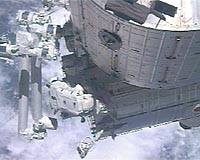
Astronauts added a storage unit on top of Japan's new laboratory at the International Space Station (ISS) on Friday, making the orbiting outpost's biggest facility even roomier.
The storage module was brought to the station by a US space shuttle in March while the bus-sized Kibo lab was delivered and installed this week by the Discovery mission.
Working 210 miles (338 kilometers) above Earth, US astronauts Karen Nyberg and Greg Chamitoff used the station's robotic arm to move the unit 30 feet (nine meters) from a temporary spot on the ISS to its new home atop Kibo.
Ghe module, which will store experiments conducted inside the 11.2-meter (36.7-feet) long lab, will be opened on Monday.
Installing and outfitting the Kibo lab has been the central mission of the space shuttle Discovery team that arrived at the station on Monday with the 15-tonne facility.
After the lab was attached to the station, Japanese astronaut AkihikoHoshide opened the huge room for the first time on Wednesday, giving Japan its first manned space facility.
Mission specialists Mike Fossum and Ron Garan conducted a seven-hour spacewalk on Thursday to attach front and rear television cameras outside the science lab and make preparations for the storage unit's installation.
Kibo — which means "Hope" in Japanese — represents Japan's and Asia's first major contribution to the orbiting international station, which already has modules from the United States, Russia and the European Space Agency.
The lab's third main component, an exterior "balcony" to hold experiments exposed to the microgravity of space, will be delivered to the station during a shuttle mission next year.
When completed, Kibo will allow the station, which usually has three crew members, to double its occupancy to six people.
The lab will allow astronauts to carry out experiments in medicine, biology and biotechnology, material production and communications, both in a pressurized environment and completely exposed to space.
