
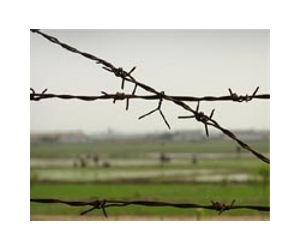
South Korea will display Christmas lights near its tense border with North Korea for the first time since 2004 following the regime's deadly artillery attack last month, military officials said Wednesday.
The South has partially resumed a cross-border propaganda campaign since the March sinking of a South Korean warship and the bombardment of a border island, which killed four people including civilians and sparked outrage.
Since the attack, the first on a civilian area since the 1950-53 war, Seoul has also staged a series of military drills in a show of strength against Pyongyang.
The defence ministry said it has approved a request by the Seoul-based Yoido Full Gospel Church to set up Christmas lanterns on a steel tower atop a military-controlled hill.
The church is expected to switch on the lights on December 21 on the 155-metre (yard) hill, which is just three kilometres (two miles) from the border and overlooks the North's Kaesong city, it said.
The two Koreas in 2004 reached a deal to halt cross-border psychological operations and the South stopped the church from switching on the lights to mark Christmas and Buddha's birthday.
The communist North had accused the South of displaying Christmas lights to spread the religion among its people and soldiers. The North's constitution provides for religious freedom, but the US State Department says this does not in practice exist.
Seoul began preparing to restart its propaganda war following the sinking of the warship with the loss of 46 lives. It installed loudspeakers along the land border but has not yet switched them on.
Seoul says a North Korean torpedo sank the ship, a charge denied by Pyongyang.
Soon after last month's artillery attack, the South's military reportedly floated 400,000 leaflets across the border denouncing the North's regime.
"There is no reason for our side to abide by the 2004 agreement because of North Korea's military provocations," a defence ministry spokesman told AFP, declining to confirm the leaflet launches.
The loudspeakers are designed to blast anti-regime and pro-democracy messages deep into the border region — up to 24 kilometres (15 miles) at night and 10 kilometres during the day.
North Korea, one of the world's most closed societies, has threatened to open fire on the loudspeakers if they are switched on, and also to fire at locations from where balloons carrying leaflets are released.
In addition to the reported military operation, private activist groups frequently float huge balloons across the heavily fortified frontier. These carry tens of thousands of leaflets denouncing the regime of Kim Jong-Il.
earlier related report
S.Korea holds mass drill amid concern at North's nuke plans
Seoul (AFP) Dec 15, 2010 –
Air-raid sirens wailed and city traffic halted Wednesday as South Korea staged its biggest-ever civil defence drill, amid high tensions with North Korea and a US warning about Pyongyang's nuclear programme.
Pavements in Seoul and other cities quickly emptied as pedestrians scurried into buildings and subway stations during the 15-minute exercise, the most extensive since a civil defence law was passed in 1975.
The military said 12 jet fighters were mobilised, with one overflying the capital of 10 million people, to simulate air strikes by the North.
Some Seoul residents found it hard to take the exercise seriously in a gleaming modern city which has been at peace since the end of the 1950-53 war.
"People don't care about these exercises because we think the North Koreans will never hit Seoul," said businessman Choi Duk-Soo, calling for more realistic drills.
But the National Emergency Management Agency said the situation is grave after the North's deadly artillery attack on a border island on November 23 — the first shelling of a civilian area in the South since the war.
"Public concern has been growing over North Korea's provocations," it said in a statement, citing continued military threats, high tensions in the Yellow Sea and the possibility of a third nuclear test by Pyongyang.
The North's November 12 disclosure to visiting US experts of an apparently operational uranium enrichment plant sparked international concern that it may soon have a new source of bomb-making material.
It says this is part of a peaceful atomic energy programme. But US experts say the plant could easily be reconfigured to produce weapons-grade uranium to augment the country's plutonium stockpile.
The US State Department said Tuesday the North has "at least one other" uranium enrichment site apart from the one disclosed at the Yongbyon complex.
"This remains a significant area of concern," said spokesman Philip Crowley.
The New York Times, citing anonymous US administration officials, said the new facility was "significantly more advanced" than work done by Iran.
South Korea's Chosun Ilbo newspaper, quoting intelligence sources, said the North had dug a tunnel more than 500 metres deep at its nuclear test site in possible preparation for another test.
"If progress goes on at the current pace, the North will have dug a cave one kilometre deep, the depth where it is possible to conduct a nuclear test, between March and May next year," one official was quoted as saying.
Diplomats are touring the region to discuss a response both to the artillery attack which killed four people and the potential new nuclear threat.
Russia's Foreign Minister Sergei Lavrov, at a meeting Monday with his visiting North Korean counterpart Pak Ui-Chun, expressed "deep concern" about the new uranium capability.
China, the North's sole major ally, has called for a new meeting of six-party envoys to resolve the latest crisis on the peninsula.
But the United States, Japan and South Korea say a return to negotiations at this point could be seen as rewarding the North's aggression.
They want China, which has failed publicly to condemn its ally for the island attack, to take a tougher line.
US Deputy Secretary of State James Steinberg and other US officials have left for Beijing and are expected to press it to take tougher action.
"We hope that China will work with us to send a clear, unmistakable message to North Korea that they have to demonstrate a seriousness of purpose and end their provocative actions," US ambassador to South Korea Kathleen Stephens told a Seoul lunch meeting.
Share This Article With Planet Earth
