
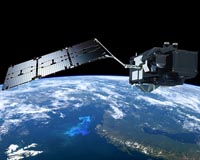
Sentinel satellites are at the heart of Copernicus, Europe's largest Earth observation programme. Sentinels are already reliably and continuously providing large amounts of data on the state of the climate, vegetation and oceans. Now, six more 'Earth Guardians', the High Priority Candidate Missions (HPCM), are being added.
"At the Space 19+ European Space Agency (ESA) Council Meeting at Ministerial Level held in Seville in November 2019, Germany set the course for a strong commitment to European spaceflight," explains Walther Pelzer, Member of the German Aerospace Center Executive Board and Head of the DLR Space Administration.
"Now, Germany's space industry will play a major role in the expansion of the world's most powerful space infrastructure for the provision of global environmental information." On 1 July 2020, ESA awarded contracts worth more than 2.5 billion euro for the development and construction of the HPCM satellites, around 800 million euro of which will go to space companies in Germany.
Investment in ESA programmes supports the German space industry
At the ESA Council meeting at ministerial level in November 2019, Germany committed approximately 3.3 billion euro for future space programmes and, with a subscription of almost 23 percent, became ESA's largest contributor. Investments in the field of Earth observation were increased to 720 million euro.
"These investments are now flowing back to Germany in the form of contracts," says Pelzer. "What is particularly pleasing here is not only the strengthening of the space industry as a whole, but, above all, the very high volume of orders – around 24 percent – for small and medium-sized enterprises, which form the backbone of the space industry in Germany."
More than 1000 high-tech jobs in hardware development will be secured for years to come by the planned expansion of Copernicus, thus continuing the international leadership role that Germany holds in Earth observation. Copernicus will also develop innovative services and technologies that provide new opportunities for commercial applications – for example in the area of 'Big Data' – and thus offer a wide range of opportunities for start-up companies in the space industry.
Climate and environmental protection as a global challenge
"Already today, the extensive datasets from Copernicus are helping to find answers to the global challenges posed by climate change, population growth and environmental problems," says Jorn Hoffmann, Programme Manager for Copernicus at the DLR Space Administration.
"The information is also the basis for numerous services and applications in areas such as environmental protection, agriculture, transport and disaster relief."
The Copernicus system delivers a data volume of approximately 25 terabytes per day, which is roughly equivalent to the data capacity of 1000 Blu-ray discs. If these discs were stacked on top of each other, after a year the tower would be three times the height of the Cologne Cathedral. The six new High Priority Candidate Missions are intended to make the Copernicus system even more powerful and expand its range of applications.
Overview of the new missions:
+ CO2M (Copernicus Anthropogenic Carbon Dioxide Monitoring) will use infrared instruments to measure the concentrations of carbon dioxide, methane and nitrogen dioxide in the atmosphere, distinguishing between anthropogenic greenhouse gases and natural sources.
+ CO2M will thus help to monitor achievement of the targets set out in the Paris Climate Change Agreement. The Prime Contractor is OHB SE, which has its headquarters in Bremen.
+ LSTM (Copernicus Land Surface Temperature Monitoring) will measure the temperature of the land surface. This is of particular interest for agricultural applications, as the surface temperature can be used to determine the amount of evaporation. This supports agricultural applications and large-scale water management, as well as enabling more accurate prediction of droughts and improved counteraction of desertification. Other applications include fire detection and monitoring.
+ CRISTAL (Copernicus Polar Ice and Snow Topography Altimeter) is designed to determine the thickness of ice masses in the Arctic and Antarctic and to measure the thickness of the ice layer on the oceans. Among other things, the mission will make an important contribution to predicting changes in sea level. The Prime Contractor is Airbus Friedrichshafen.
+ CIMR (Copernicus Imaging Microwave Radiometer) will monitor the ice cover and surface temperature of the oceans. These data will be used in climate research and operational ice services for maritime applications. The most important German industrial partner is HPS GmbH in Munich.
+ ROSE-L (Radar Observing System for Europe at L-band), a synthetic aperture radar mission, will classify land surface cover and be able to determine the moisture content of soils as well as soil subsidence. ROSE-L will also be capable of detecting polar ice sheets and the extent of sea ice surfaces. The mission will support applications in agriculture, forestry and maritime services. The main participants in Germany are Airbus in Friedrichshafen and DLR in Oberpfaffenhofen.
+ CHIME (Copernicus Hyperspectral Imaging Mission) will perform imaging spectroscopy of the land surface. This will support applications in agriculture – for example, by providing information on plant health or yield forecasts – in environmental protection, and in the extraction of mineral resources. The most important German industrial partner is OHB in Oberpfaffenhofen.
