
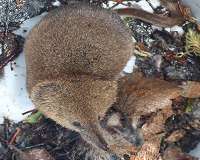
While the rest of us are packing on winter weight in preparation for the cold months ahead, the common shrew is shrinking — it's head.
"We found that each shrew undergoes a dramatic decrease in braincase size from summer to winter," Javier Lazaro, scientist with the Max Planck Institute for Ornithology in Germany, said in a news release. "Then, in spring, the braincase regrows, almost reaching the original size in the second summer."
Scientists have previously observed the Dehnel phenomenon, named for the first person to describe it, but the latest study is the first to follow individual shrews through the seasons.
Scientists captured shrews and recorded X-rays of their entire body. They also microchipped each shrew for future identification. The researchers recaptured each specimen twice more to document the change in head size.
The X-rays revealed the expected pattern: a maximum head size in summer, a significant shrinkage in winter and an expansion in spring.
The results of their observations — shared in the journal Current Biology — showed the shrew's head, skull and brain mass shrunk between 20 and 30 percent during the winter. The research also showed the entirety of the shrew's body shrinks, organs and all — but not as significantly as the brain.
Shrews don't hibernate or migrate, so researchers hypothesize the seasonal shrinkage may be a technique for surviving the winter.
"Reducing head size — and thus brain size — might save energy disproportionally as the brain is energetically so expensive," Lazaro said.
Researchers aren't entirely sure how the shrinkage process works, but they believe the skull shrinks as the collagen composing brain joints, or cranial sutures, is resorbed.
Birds help raise other's offspring with the expectation of future benefits
New research suggests birds without a brood help raise the offspring of others with the hope of future benefits – like extra parenting help and new territory.
In roughly 10 percent of bird species, some individuals will delay producing offspring and help care for the newborn chicks of their peers. The behavior has also been observed among a small percentage of mammals, fish and insects … read more
