
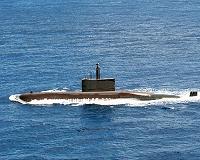
A 1,400-ton diesel submarine for the Indonesian navy has been launched by South Korea's Daewoo Shipbuilding & Marine Engineering Co.
Yonhap news agency reports the submarine is the second of the three submarines being built under a 2011 deal worth $1.1 billion.
The first vessel was launched in March, according to Daewoo Shipbuilding spokesman Yoon Yo-han.
The submarines are modified versions of the Chang Bogo-class vessels currently in service in the South Korean navy.
Daewoo Shipbuilding is set to deliver the first and second submarines to Indonesia in March and October next year, respectively. The third submarine is scheduled for 2018 delivery.
DARPA tests Sea Hunter sub-tracking drone
Washington (UPI) Oct 25, 2016 –
The U.S. Defense Research Advanced Projects Agency's Continuous Trail Unmanned Vessel, or ACTUV, was recently tested off the California coast, the agency said Monday.
The ACTUV prototype, christened Sea Hunter, underwent testing in open waters and seeks to pave the way for a new kind of vessel that can travel long distances, unmanned, for a month at a time, the agency said in a statement.
ACTUV's missions could include submarine tracking and counter-mine activities.
The ACTUV prototype had the agency's Towed Airborne Lift of Naval Systems, or TALONS, array on board, which could be towed behind boats or ships while conducting intelligence, surveillance and reconnaissance missions at heights of up to 1,500 feet, higher than current ship masts.
Over two when TALONS was flown for 90 minutes each day, the prototype started nested on the ACTUV before expanding its parachute and rising to 1,000 feet.
After its sensors and communications equipment were tested, it reeled itself back into the nest.
TALONS showcased a radio and sensor range that was six times what such arrays can reach at sea level, the agency said.
DARPA reached an agreement with the U.S. Navy to jointly fund the ACTUV prototype in 2014.
A christening ceremony was held in April to mark the vessels transition from a DARPA-led project to open water testing with the Navy.
It could transition fully to the sea service by 2018.
