
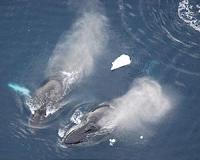
Scientists have for the first time surveyed the unique community of microorganisms — the microbiome — living inside the blowhole of a humpback whale. They did so with the help of a six-rotor hexacopter.
Researchers with the Woods Hole Oceanographic Institution used a custom-built drone to collect blow samples, the moist breath exhaled by whales, from 17 humpbacks off the coast of Cape Cod and from nine humpbacks swimming near Canada's Vancouver Island. The scientists sequenced the genetic material found in the blow samples to identify the microbes living in each whale's respiratory tract.
"We were using the drone to take aerial images of the whales, so that we could assess body conditions," NOAA researcher John Durban said in a news release. "Because of the stable flight performance of our hexacopter, we quickly learned that we could reliably fly through whale blow without disturbing the animals."
The biologists involved in the study — published this week in the journal mSystems — believe a better understanding of the humpback's microbiome will help them monitor whale health.
"The pulmonary system is a common site for bacterial infections in whales," said WHOI researcher Amy Apprill. "We see evidence of respiratory illnesses frequently in stranded and deceased animals. Until now, little has been known about the normal respiratory microbiome of healthy whales."
Microbe samples sequenced from the blow samples revealed a common, or core, microbiome shared by all 26 whales — a microbiome distinct from the microbial communities found in seawater.
"From this study, we have a good idea of what a normal, healthy whale microbiome looks like. Now we need to understand what the microbiome of an unhealthy whale looks like," Apprill said. "This comparison is critical for health monitoring and disease detection."
Japan kills 177 whales in Pacific campaign: government
Japan said Tuesday it killed 177 whales off its northeast coast in an annual hunt that sparks anger among animal rights activists and others.
Three ships which left port in June returned with 43 minke whales and 134 sei whales, the number stipulated beforehand, according to the country's fisheries agency.
Japan is a signatory to the International Whaling Commission's (IWC) moratorium on … read more
