
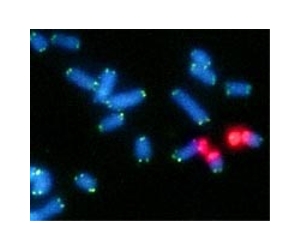
U.S. scientists say they've achieved a major milestone in the attempt to assemble, in a test tube, entire chromosomes from their component parts.
Researchers at Penn State University say discovering the process a cell uses to package the basic building blocks of an organism's entire genetic code is expected to help hasten the search for remedies to many human diseases, a university release reported Thursday.
"Our procedure starts with an entire genome of DNA from yeast cells that we propagate through bacteria, then purify," molecular biologist B. Franklin Pugh said. "Next, we add equal parts of pure histones, the protein building blocks of chromosomes. Then we allow the assembly process to begin."
The technique will allow scientists to probe experimentally the structure and function of chromosomes and their component genes in ways that were not possible before, the researchers said.
"The cell protects chromosomes from the outside environment, including probing scientists," Pugh said. "We now have a way to study the components of the chromosome outside the protective confines of the cell."
Share This Article With Planet Earth
