
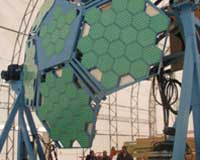
The Geodesic Dome Phased Array Antenna Advanced Technology Demonstration housed in the large white hangar near the Colorado Tracking Station, continues to progress toward its goal of demonstrating advanced capabilities for contacting Department of Defense satellites.
The next step for the system in becoming fully operational is connection to the Air Force Satellite Control Network, scheduled to start Jan. 16.
"It's exciting that live satellite contacts will start in early February and continue through May," said Gary Wambold, 50th Space Wing Plans and Programs. "We're getting closer to being able to demonstrate the full range of capabilities this antenna can provide to our AFSCN user community."
A phased array antenna connected to two co-located portable ground stations, as well as the CTS ground station equipment, will be used to accomplish standard AFSCN satellite supports. Satellite operation centers from the 50th Space Wing, NASA and others will participate in this demonstration.
The demonstration, a jointly sponsored effort by the Space and Missile Systems Center and Air Force Research Laboratory, is a representation of the next step in the development of this type of antenna technology able to provide more flexible, responsive and reliable satellite telemetry, tracking and commanding capabilities for the Air Force while reducing life cycle operating costs.
The antenna is a follow-on effort to the 2004 Space Battlelab Initiative, Phased Array for TT and C, which has successfully contacted NASA and DoD Low Earth Orbiting satellites. The ATD antenna is made of a six-panel section of a 10-meter equivalent GDPAA antenna and is capable of contacting satellites in geosynchronous as well as low and medium Earth orbits.
"The team has leveraged small business innovative research projects and modern DoD acquisition practices to bring phased array technology to the AFSCN," said Capt. Jason Spindler, SMC project manager for the ATD. "Each step has been a building block, and this demonstration is another monumental step in advancing satellite operations to meet increasing warfighter needs."
In conjunction with 22nd Space Operations Squadron technicians and network schedulers, Ball Aerospace, the main contractor for the project, began testing the antenna to characterize beam patterns, confirm transmit and receive capabilities and ensure function as expected.
"Things are progressing very well and we're on schedule to meet our goals," said Gary Scalzi, Air Force Research Lab Government Demonstration Director for the ATD. "The support from Schriever has been tremendous and we look forward to continuing our work together and making this project a success."
Due to the ongoing tests, the northeast corner of the controlled area on Schriever continues to be restricted. While no hazard is believed to exist, the establishment of a temporary restriction from entering the testing area is a safety precaution until final analysis is completed.
Share This Article With Planet Earth
