
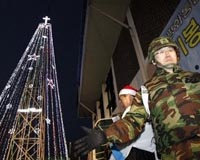
South Korea said Thursday it would resume propaganda broadcasts into North Korea, a tactic that prompted Pyongyang to threaten military strikes when it was last employed during a cross-border crisis last year.
The decision to resume the high-decibel broadcasts using massive batteries of speakers on the heavily militarised frontier was taken in response to the North's latest nuclear test on Wednesday, an official at the presidential Blue House said.
"The North's fourth nuclear test is a wanton violation of its international obligations … and a grave violation of the inter-Korea agreement on August 25," the official said.
"So the South Korean government decided to resume the border broadcast into the North as of noon (0300 GMT) on Friday," he added.
The August 25 agreement ended an extended and increasingly hostile standoff that had brought the two Koreas to the brink of an armed conflict.
After North Korea "expressed regret" for mine blasts that maimed two patrolling North Korean soldiers, the South turned off the banks of loudspeakers that had been blaring music and propaganda messages across the border for two weeks.
But the deal included a formula agreed by both sides that the loudspeakers would remain unplugged "unless an abnormal case occurs".
The South's decision to resume was presumably based on the argument that Wednesday's test qualified as "abnormal."
At the height of last year's crisis, the North had issued an ultimatum for the South to halt its "psychological warfare" or face imminent attack.
S. Korea restricts entry to joint industrial zone in North
Seoul (AFP) Jan 7, 2016 –
South Korea said Thursday it was imposing partial restrictions on entry to a joint industrial complex in North Korea, a day after the hermit kingdom shocked the world with its fourth nuclear test.
The Unification Ministry said it will only permit South Korean businessmen and those directly involved in the operation of the Kaesong Industrial Complex to cross the border for the time being for safety concerns.
"The entry restriction is a measure to ensure the safety of the citizens in this state of emergency," a ministry official told AFP, asking not to be named.
Around 500 South Koreans still crossed the border to Kaesong on Thursday, but the official said the number would quickly be reduced.
The move was described as "an initial countermeasure", with the official suggesting further Kaesong-related restrictions could be imposed in the future.
"Once we get the full picture of international sanctions on North Korea, the measure will need to be reviewed," the official said.
With backing from China, Pyongyang's sole major ally, the 15-member UN Security Council on Wednesday strongly condemned the test and said it would begin work on a new UN draft resolution that would contain "further significant measures".
The Kaesong industrial estate opened in 2004 and currently hosts more than 120 South Korean companies which employ some 53,000 North Korean workers.
The estate is a precious source of hard currency for the isolated and impoverished North. The South Korean firms get cheap labour as well as preferential loans and tax breaks from the government.
The business park — virtually the last remaining form of economic cooperation between the Koreas — has become increasingly vulnerable to turbulent swings in inter-Korea politics.
In 2013, during a period of heightened cross-border tensions, Pyongyang effectively shut down the zone for five months by withdrawing its workers.
