
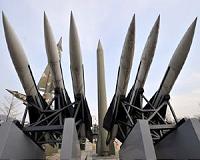
North Korea fired another short-range missile off its east coast on Friday, South Korean officials said, as regional leaders met in Washington to discuss the threat of Pyongyang's nuclear weapons programme.
It was the latest in a series of North Korean missile launches during what has been an extended period of elevated military tension on the Korean peninsula, triggered by Pyongyang's fourth nuclear test on January 6.
The launch came as the South Korean coastguard reported that around 70 fishing vessels had been forced back to port after GPS navigation issues caused by North Korean radio-wave jamming.
South Korea's defence ministry said the surface-to-air missile was fired at around 12:45 pm (0345 GMT) from the eastern city of Sondok.
The range and precise trajectory could not immediately be confirmed, a ministry official said. The South's Yonhap news agency said it flew 100 kilometres (60 miles) into the East Sea (Sea of Japan).
The launch came in the middle of a two-day nuclear security summit being hosted by Barack Obama in Washington, at which North Korea has been the focus of the US president's talks with the leaders of China, South Korea and Japan.
Obama spoke Thursday of the need to "vigilantly enforce the strong UN security measures" imposed on the North after its latest nuclear test and subsequent long-range rocket launch.
Pyongyang's state media has labelled the summit a "nonsensical" effort to find fault with the North's "legitimate access to nuclear weapons".
Existing UN sanctions ban North Korea from conducting any ballistic missile test, although short-range launches tend to go unpunished.
Last month, the North upped the ante by test-firing two medium-range missiles, which were seen as far more provocative given the threat they pose to neighbours like Japan.
Earlier Friday, Seoul said North Korea was using radio waves to jam GPS signals in South Korea, affecting scores of planes and vessels.
The coastguard said 71 out of 332 fishing boats that set out for sea on Friday morning had to return after GPS problems compromised their navigation systems, Yonhap reported.
"North Korea's GPS jamming is a clear act of provocation… we call for an immediate end to it," the South's defence ministry said in a statement.
"If North Korea continues its GPS jamming attempts despite our we will — with close cooperation with the international community — make North Korea pay the price," the statement said without elaborating.
N. Korean leader guides new anti-air weapon system: Pyongyang
Seoul (AFP) April 2, 2016 –
North Korean leader Kim Jong-Un has overseen the test of a new anti-aircraft weapon system, state media said Saturday, the latest in a series of missile trials as tensions run high on the divided Korean peninsula.
Over the past month the young leader has supervised several military drills, including the test-firings of medium ballistic missiles, a multiple rocket system and long-range artillery, in response to Seoul-Washington joint army drills south of the border.
The latest launch came as a two-day nuclear security summit was being hosted by Barack Obama in Washington, at which North Korea was the focus of the US president's talks with the leaders of China, South Korea and Japan.
Pyongyang's official KCNA news agency said Saturday Kim "guided the test of a new-type anti-air guided weapon system" to check its capability.
"Under his observation, AA rockets were fired to accurately hit mock enemy aerial targets", it said.
The South's defence ministry said the North fired an anti-air missile around 12:45 pm (0345 GMT) Friday from the eastern city of Sondok.
Kim "expressed great satisfaction over the successful test", calling it another striking demonstration of the the rapidly growing defence capability of the country, KCNA said.
Obama spoke Thursday of the need to "vigilantly enforce the strong UN security measures" imposed on the North after its fourth nuclear test in January and a subsequent long-range rocket launch.
Pyongyang's state media labelled the summit a "nonsensical" effort to find fault with the North's "legitimate access to nuclear weapons".
Existing UN sanctions ban North Korea from conducting any ballistic missile test, although short-range launches tend to go unpunished.
