
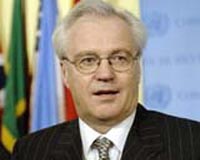
Russia's decision to begin withdrawing from Syria will help Moscow's push to reach a political settlement, the Russian ambassador to the United Nations said Monday.
"Our diplomacy has received marching orders to intensify our efforts to achieve a political settlement in Syria," Ambassador Vitaly Churkin told reporters ahead of a UN Security Council meeting on Syria.
"We are in the political mode now, in the cessation of hostilities mode."
President Vladimir Putin announced the withdrawal that will begin on Tuesday just as a new round of peace talks got under way in Geneva to try to end the five-year war.
"We think that our forces have operated very effectively," said Churkin.
"Our military presence will continue to be there. It will be directed mostly at making sure that the ceasefire, the cessation of hostilities is maintained," he added.
Russia launched the air strikes in September to root out the Islamic State group that controls part of Syria, but the military campaign mostly propped up Syrian leader Bashar al-Assad.
Churkin declined to specify whether Moscow would halt all air strikes, saying instead that the forces staying behind will enforce the ceasefire that began in late February.
Russia has gained the upper hand in Syria with its military intervention, but diplomats say it remains unclear whether they can impose a settlement on Assad.
Churkin said he would inform the Security Council on Russia's withdrawal plan during a closed-door meeting called to hear UN envoy Staffan de Mistura report on the latest round of talks.
The UN-hosted negotiations in Geneva, which began on the eve of the fifth anniversary of the outbreak of the conflict, are the latest effort to end violence that has killed more than 270,000 people and displaced millions.
Syria: key dates since the Russian intervention
Moscow (AFP) March 14, 2016 –
Russia, a loyal ally of the regime of President Bashar al-Assad, has since late September been carrying out air strikes in Syria.
Moscow says the strikes are aimed at "terrorists", notably the jihadist Islamic State, but it faces accusations of hitting non-jihadist rebels and civilians as it seeks to bolster Assad.
A timeline:
– Military intervention –
– September 30, 2015: Russia, at the Damascus regime's request, launches air strikes on Syria, saying it has hit IS targets.
However, the Syrian Observatory for Human Rights monitor says the strikes were mainly targetted at the Al-Nusra Front, Syria's branch of Al-Qaeda, and Islamist rebels.
– Russian President Vladimir Putin says Moscow must act preemptively to destroy jihadists in Syria before they present a threat closer to home.
– On October 7 for the first time Russian warships in the Caspian Sea fleet join in strikes in Syria with a volley of cruise missile attacks.
– Washington says that almost all the Russian strikes are aimed at moderate armed groups who are fighting the regime.
– Diplomatic offensive –
– October 20, 2015: After three weeks of Russian air strikes, Putin launches a diplomatic initiative and invites Assad to Moscow for a high-profile visit.
– November 14: After a first meeting on October 30, the big powers, including Russia, the United States, France, and for the first time Iran meet in Vienna where they agree on a fixed calendar for Syria but remain sharply at odds over the future of Assad.
– Russia-Turkey crisis –
– November 24: Tensions soar between the two rival players in the Syria war when Turkey shoots down a Russian warplane on the Syrian border, saying it has violated its airspace.
– Civilian victims and Aleppo offensive –
– December 23: Amnesty International says Russian air raids have killed "hundreds of civilians" in Syria, many in targeted strikes that could constitute war crimes. Russia's defence ministry says the report consists of "cliches and fakes."
– February 1, 2016: Syrian regime forces, backed by Russian air strikes, launch an offensive against rebels around the northern city of Aleppo, prompting an exodus by tens of thousands of civilians.
– In early March, 2016, the Syrian Observatory for Human Rights says that more than 1,700 civilians including 429 children have died since the beginning of the Russian intervention.
– A US-Russian intiated truce –
– February 27: An unprecedented "cessation of hostilities", initiated by Washington and Moscow comes into force. It applies to combat zones between Russian-backed regime forces and non-jihadist rebels, but does not apply to the more than half of the country's territory that is controlled by extremist groups.
– Russian withdrawal –
– March 14: Putin orders the defence ministry to begin the withdrawal of Russian forces from Syria from Tuesday.
The Russian deployment has turned the tide in Assad's favour, rescuing his regime from the brink of collapse.
