
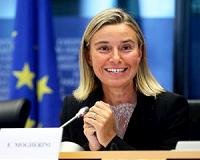
EU foreign affairs head Federica Mogherini warned Monday that Russian intervention in Syria was a very high-risk "game-changer" as the international community seeks a political solution to the war.
"It is for sure a game-changer, it has some very worrying elements… it has to be coordinated, otherwise it risks being extremely dangerous, not only from a political point of view but also military," Mogherini said.
She said Russian military support for long-time Moscow ally President Bashar al-Assad had to be directed against the extremist jihadi fighters of Islamic State, not against the rebel groups seeking his ouster backed by the West.
Moscow says its air and missile strikes include IS, but the West believes they seek to bolster Assad's position and let him to retake ground lost in the past 18 months.
The 28-nation European Union is divided over what role Assad can play in a solution to a conflict which has claimed some 250,000 lives so far.
Mogherini refused to be drawn one way or the other as she arrived for an EU foreign ministers' meeting in Luxembourg dominated by the crisis.
She said the EU would put all its energy to support UN efforts to broker a peace deal and "this is a process which has to have all the relevant actors around the table."
British Foreign Secretary Philip Hammond warned that while there could be some flexibility on working with Assad, there were serious risks too of driving the rebels into the arms of IS.
"We are very clear that we cannot work with Assad as the long-term solution for the future of Syria," Hammond said.
"We can be flexible about the manner … the timing of his departure, but if we try to work with Assad, we will only drive the opposition into the arms of IS, the very opposite of the outcome that we want," he said.
A draft statement of the meeting's conclusions on Syria seen by AFP refers to a "peaceful and inclusive transition," without mentioning Assad.
It adds however: "There cannot be a lasting peace in Syria under the present leadership and until the legitimate grievances and aspirations of the Syrian society are addressed."
Russian President Vladimir Putin said Sunday that Russia's military actions in Syria were meant to "stabilise the legitimate authorities and create conditions for finding a political compromise."
EU demands 'immediate' halt to Russia strikes on moderate Syrian rebels
Luxembourg (AFP) Oct 12, 2015 –
The EU demanded Monday the "immediate" halt of Russian air strikes against moderate Syrian rebel groups, adding that a lasting peace was impossible under Moscow-backed President Bashar al-Assad.
"The recent Russian military attacks that go beyond Daesh (Islamic State) and other UN-designated terrorist groups, as well as on the moderate opposition, are of deep concern and must cease immediately," the EU's 28 foreign ministers said in a statement.
The ministers, meeting in Luxembourg for talks dominated by the Syrian crisis, said Russia's military action only made the problem worse and weakened efforts to reach a peaceful solution.
"This military escalation risks prolonging the conflict, undermining a political process, aggravating the humanitarian situation and increasing radicalization," they said.
They urged Russia to "focus its efforts on the common objective of achieving a political solution to the conflict."
The statement comes ahead of a summit of EU leaders on Thursday where Syria will also be high on the agenda.
Ministers also said that as the crisis deepened, it became imperative to end a conflict which has claimed some 250,000 lives and driven some 12 million people — half the population — to flee their homes.
They said this required "a peaceful and inclusive transition" but it was not clear if Assad would have any role in it, perhaps reflecting sharp divisions over his immediate future.
For the longer term, ministers agreed he had no place in Syria.
"There cannot be a lasting peace in Syria under the present leadership," it added.
Russian President Vladimir Putin said Sunday that Russia's military actions in Syria were meant to "stabilise the legitimate authorities and create conditions for finding a political compromise."
