
Russia's Space Defense Forces have confirmed that the Briz-M propellant upper stage fell apart in the near-Earth orbit on October 16. Space Forces spokesman Colonel Alexei Zolotukhin said Monday the command was closely monitoring whereabouts of the 12 fragments that the rocket split into.
Astronomers reported earlier they had detected several dozen chunks of debris in the orbit scattered along the estimated Briz-M trajectory.
A spokesperson with Russia's missions control center reassured journalists the space junk posed no direct threat to the International Space Station.
related Zarya.Info report
SpaceTrack Data Points to Briz-M Explosion Date/Time
Late October 24, SpaceTrack issued element sets relating to eighty items of Debris in orbits similar to that occupied by the Briz-M Rocket that launched Telkom 3 and Express MD-2 into unusable orbits on August 6.
The total is a few more than the twelve claimed by Russia but falls well short of the 1000+ count attributed to a SpaceTrack quote a few days ago.
The Briz-M and its attached Auxiliary Propellant Tank were last reported on October 16 with a Twoline orbital Elements set having an Epoch just after 18:00 UTC. It showed the object to be in an orbit 264 km x 1512 km at 49 degrees .9 inclination.
SpaceTrack reported later the same day that it was analysing debris resulting from fragmentation of the rocket. It took another eight days before orbit data was released into the public domain.
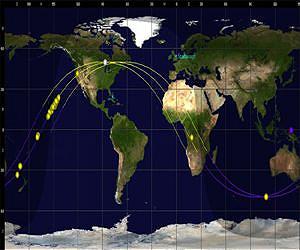
Orbital plots created using the Orbitron satellite tracking programme indicate that the disintegration occurred at 16:00 UTC +/-30 minutes on October 16.
This is earlier than the Epoch on the final element set but it has to be remembered that element sets are computed from multiple observations and then an orbit is calculated for a set time. An element set is constructed using that time.
The discrepancy indicates that the observational data was collected at about the time of the explosion and then projected forward to the beginning of the next circuit of the Earth.
Most of them are bunched closely together. A small number are scattered around the orbit. The reason for the scatter is uncertainty in the decay rates contained in the element sets that were issued eight days after the event.
