
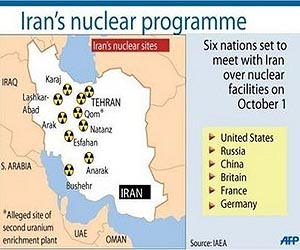
Russia on Wednesday warned a strike against Iran could have "catastrophic" consequences and urged nations not to draw early conclusions from this week's failed mission by UN nuclear experts.
"The scenario of military action against Iran would be catastrophic for the region and possibly the whole system of international relations," Deputy Foreign Minister Gennady Gatilov told a news conference.
His comments came after a five-strong delegation from the UN's International Atomic Energy Agency (IAEA) left empty-handed following two days of talks focusing on suspected military aspects of the country's nuclear programme.
Chief nuclear inspector Herman Nackaerts said the team "could not get access" during the visit to Iran's military site in Parchin where suspected nuclear warhead design experiments were conducted.
Russia has longstanding commercial and military ties with Iran and has condemned recent unilateral sanctions imposed by the United States and the European Union over its suspected pursuit of nuclear arms.
Gatilov urged nations to wait for the IAEA's official report before deciding to condemn Iran for failing to cooperate with the agency.
"I would not make any profound conclusions from the IAEA mission that dialogue failed and we reached a dead end," said Gatilov.
"We are not dramatising the situation."
A spokesman for the foreign ministry separately said that inspectors had visited Parchin on at least one previous occasion and had not yet fully explained why they needed to visit the site again.
The United States and its chief regional ally Israel have never ruled out a military strike against Iran over its controversial nuclear programme but Russia has always insisted the standoff can only be solved through diplomacy.
Russia said it was particularly concerned that a strike against Iran could be launched from an air base the United States leases in Central Asia's ex-Soviet state of Kyrgyzstan.
The US base at Manas is currently used as a key coalition hub for operations in nearby Afghanistan.
"It cannot be excluded that this site could be used in a potential conflict with Iran," foreign ministry spokesman Alexander Lukashevich told reporters. "We hope that such an apocalyptic scenario will not be realised."
"The statements from Washington which do not rule out a military solution to the Iranian nuclear crisis have caused serious worries in the Central Asian region," he said.
Iran not seeking atomic weapon: supreme leader
Tehran (AFP) Feb 22, 2012 –
Iran's supreme leader Ayatollah Ali Khamenei insisted on Wednesday that his country is not seeking an atomic weapon, following an unsuccessful visit to Tehran by UN nuclear watchdog officials.
"We are not after an atomic weapon. We want to break the supremacy (of the world powers) that relies on nuclear weapons. God willing, the nation will reach this goal," he told a meeting with Iranian nuclear scientists, according to an official government statement.
"Despite what the enemy (the West) says, nuclear energy is directly linked to our national interests," Khamenei said, urging the scientists to "continue the important and substantial" nuclear work.
Khamenei's reiteration of Iran's longheld stance came after a five-strong delegation from the UN's International Atomic Energy Agency left Tehran empty-handed following two days of talks focused on suspected military aspects of Iran's nuclear programme.
The UN nuclear inspector heading the team, Herman Nackaerts, said on his return to Vienna the Iranians had not permitted the team to visit a military site in Parchin where apparently non-peaceful activities had been detected.
He also said "we could not formalise the way forward," signaling that the delegation left with no further talks scheduled.
The IAEA delegation was to submit its report, "then we will have to see what are the next steps," Nackaerts said.
Iran's envoy to the IAEA, Ali Asghar Soltanieh, was quoted by the Iranian news agency ISNA as saying Tuesday that the talks had been intensive and covered "cooperation and mutual understanding" between the two sides.
"These negotiations will continue in the future," Soltanieh said.
