
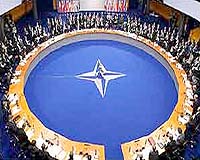
Russian President Vladimir Putin said Thursday he was ready to target missiles at former Warsaw Pact countries, including neighbouring Ukraine, if they join NATO or host Western military facilities.
Russia "would be forced to aim missiles at those objects which we feel threaten our national security," Putin told his last major annual press conference before he stands down.
Ukraine is applying to join NATO while Russia has also been infuriated at plans by the Czech Republic and Poland to host a US anti-missile defence system.
The Kremlin leader brushed off an angry reaction from Washington to similar remarks made earlier this week. US Secretary of State Condoleezza Rice described Putin's words as "reprehensible rhetoric."
Speaking two weeks before a presidential election which his hand-picked successor is sure to win, Putin insisted that Russia was a democracy and said that he had never been power hungry, despite attacks from critics who say he has created an authoritarian state.
"All these eight years I worked like a slave, from morning to night," Putin said.
However, "I was never tempted" to stay beyond a second consecutive term, the maximum allowed under the constitution, Putin said. "They say the biggest addiction is to power, but I have never felt this."
The Kremlin leader painted a rosy picture of his eight years in power, citing a booming economy and strengthening of statehood.
"I don't see any serious failures," Putin said. "All the goals we set were achieved."
Putin referred to steadily rising GDP growth, an easing off in 2007 of Russia's catastrophic demographic decline, saying Russia was now "one of the economic leaders" on a par with Thailand, Malaysia and other Asian tigers.
Putin acknowledged that Russia faced a problem with rising inflation, currently running at almost 12 percent, and said "we could have done some things more effectively."
However, he described his achievements as historic, saying that in the 1990s "we didn't have a united country. We didn't even have a national anthem." Putin said that under his rule: "We founded a state."
Putin spoke before hundreds of journalists at an annual marathon press conference in the Kremlin — the last such event before he leaves office later this year.
The press conference came just ahead of the March 2 election in which First Deputy Prime Minister Dmitry Medvedev is all but certain to win against three weak candidates.
Critics at home and abroad have described the election as rigged to ensure Medvedev's victory and the main Western election monitoring organisations have decided not to send missions.
Putin has said he is willing to serve as prime minister under Medvedev, but many observers expect him to retain more power than is traditionally given to the premier's role.
The annual press conference has in previous years lasted at least three hours with Putin fielding questions on everything from his personal life to international affairs.
Particular attention was being paid to possible statements on Kosovo, the Iranian and North Korean nuclear programmes, and controversial US plans for an anti-missile shield in eastern Europe.
earlier related report
NATO will decide who joins alliance, not Russia: spokesman
NATO member nations will decide who joins the military alliance, a spokesman said Thursday, after Russia said it could turn missiles on NATO-hopeful Ukraine to protect national security.
"The only countries that can decide on the enlargement of NATO are the NATO countries. And no other country has a say in this process," chief alliance spokesman James Appathurai said.
His remarks came after President Vladimir Putin said Russia would target missiles at Ukraine if the former Soviet state hosted any NATO bases or elements of the US missile shield.
Last month, Ukraine asked to be allowed to join the alliance's Membership Action Plan (MAP) — a precursor to membership — at the next NATO summit, which will take place in Bucharest on April 2-4.
But while its political leaders are keen to join, public opinion in Ukraine is firmly against the move, and little progress toward Kiev signing up is likely any time soon.
A January opinion poll showed that 53 percent of Ukrainians would vote against joining the North Atlantic Treaty Organisation, with only 32 percent in favour.
"NATO enlargement … is a process that dates back for decades (and) clearly contributes to security and stability," Appathurai said.
Ukraine's giant neighbour Russia is concerned about its old Cold War foe moving ever closer to its borders, and had previously warned Kiev about possible action should it sign up to the world's biggest military club.
At an annual Kremlin press conference Thursday, Putin said that if Ukraine were to host bases or parts of the US shield, Russia "would be forced to aim missiles at those targets which we feel threaten our national security."
"I am obliged to say this clearly and honestly. We do not want such a development of events," he told journalists.
So far neither Washington nor Kiev has publicly raised the possibility of Ukraine hosting such facilities. The United States is negotiating with Poland and the Czech Republic to allow parts of the missile shield on their territory.
