
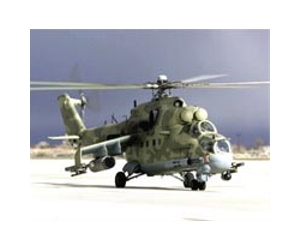
In a bizarre reversal of the past, Russia is interested in selling helicopters to Afghan President Hamid Karzai's regime.
During the 1979-1988 Soviet occupation of Afghanistan, the Soviet Army's helo force was its most effective aerial asset against the mujahedin resistance.
Russian presidential aide Sergei Prikhodko, addressing the upcoming meeting between Karzai and Russian President Dimitry Medvedev scheduled at the Russian Black Sea resort of Sochi on Aug. 18, told journalists, "The Russian side is certainly interested in it. We have no restrictions (regarding such deliveries). Deliveries of Russian helicopters will be discussed if the Afghan side raises this issue," Interfax reported on Tuesday.
Afghanistan's charge d'affaires in Russia, Hafizullah Ebadi commented during an interview, "Afghanistan definitely needs powerful national armed forces for the purpose of protecting its national sovereignty and territorial integrity. Seeking to deflect possible U.S. criticism of the initiative, Ebadi added, "Afghanistan, as an independent state, has the right to turn to any country as it seeks to meet the needs of its armed forces."
Afghanistan's turn towards Moscow for advanced aerial weaponry is an ironic reversal of the country's history three decades ago, when helicopters were one of the Soviet air force's most potent weapons in its arsenal. A month after the December 1979 Soviet intervention there were 40,000 Soviet troops in Afghanistan, facing mounting resistance. The U.S. government estimated that were about 85,000 Soviet troops in Afghanistan by late 1980 and about 100,000 by the end of 1981. As in the early days of the occupation the Soviets limited combat to the minimum needed to maintain their hold on the major cities and towns of Afghanistan, and the Afghan army, approximately 25,000 in number, was a major obstacle to Soviet aims, the Soviets concluded that it needed to use advanced heavy weaponry.
In early 1980 the Soviets began to move toward decentralized support, ensuring that reinforced units had their own artillery, engineer and helicopter support. A major element of Soviet military doctrine in Afghanistan quickly became the use of air superiority to suppress the resistance, relying heavily on helicopter assaults.
The workhorse of the Red Army's Afghan operations quickly became the Mi 24 "Hind" gunship, which the Kremlin would eventually deploy 500 to 650. The Mi 24 could carry up to 192 unguided rockets along with its machine gun and cannon armament, along with eight-12 soldiers. The Mi 24 was used not only for search-and-destroy missions but also for close air support, assaults in conjunction with fixed wing aircraft and armed reconnaissance missions.
Share This Article With Planet Earth
