
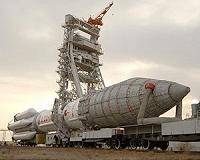
Russia's first upgraded Proton-M carrier rocket may be launched from the Baikonur Cosmodrome on May 28, a space industry source told RIA Novosti Thursday.
Earlier media reports had suggested that the launch of the latest version of the Proton-M rocket might be postponed from May 17 until late May or early June.
"The launch may be shifted to May 28 at the client's request," the source said.
The Proton-M, produced by Russia's Khrunichev State Research and Production Space Center, is the largest carrier rocket in the country's space launch vehicle fleet. The rocket has lifted dozens of Russian-made and foreign satellites since it was first launched in 2001.
The Proton-M rocket's phase four modernized version uses the Briz-M upper stage engine and is capable of placing satellites weighing up to 6,300 kilograms (6.9 US tons) into geostationary orbit.
The currently used Phase III Proton Briz-M version is capable of lifting satellites weighing up to 6,150 kilograms.
Putin Compares First LaunchFrom Vostochny CosmodromeWith Pudding
"The proof of the pudding is in the eating!" President Vladimir Putin said after a Soyuz spaceship with three Russian satellites on board lifted off from the newly-built Vostochny Cosmodrome in the Far East on Thursday.
Putin arrived at Vostochny for its first launch, scheduled to take place at 5:01am Moscow time (02:01GMT) on Wednesday. However, automatic systems canceled the launch of the Soyuz-2.1a space rocket less than two minutes before liftoff.
The Soyuz rocket eventually lifted off at 5.01 am on Thursday carrying the Mikhailo Lomonosov research satellite and two small secondary payloads.
Speaking after the launch, Putin, said it could have been carried out on Wednesday, if it was not for the technology "trying too hard."
"They say that the proof of the pudding is in the eating, and to prove that a cosmodrome is ready for work you need to have a first launch. You made it and I congratulate you," the President said.
"In 2007 we said we were going to have a complex like this and here it is. This is the first stage of a major effort and you have carried it out just fine," Putin added.
The Soyuz rocket orbited Russia's Aist-2D, Mikhailo Lomonosov and SamSat-218 research satellites.
Moscow University rector Viktor Sadovnichy said that the Mikhailo Lomonosov probe would contribute to the scientific study of particles reaching the earth from distant galaxies, powerful flares happening 500 kilometers above the surface of the earth, and keep an eye on the threats from asteroids and so-called "space junk" orbiting our planet.
