
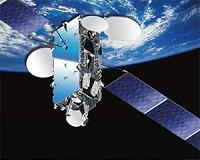
Russia has successfully launched a telecommunication satellite which was put on orbit by the jubilee mission of the Proton rocket, Roscosmos Federal Space Agency said Monday.
"Yamal-401 satellite has been placed at the designated orbit and separated from the booster," Interfax news agency quoted the Roscosmos head Oleg Ostapenko as saying.
This was the seventh Proton' s launch in 2014 and its 400th launch during the rocket' s service which has started in 1965.
Yamal has initially been put on the transitional orbit 180-km high. Later the space vehicle was elevated to its permanent geosynchronous orbit at nearly 36,000 km distance form the Earth.
The separation took place at 12:17 Moscow time (0917 GMT).
The Proton-M has experienced several failures in 2013 and 2014. The previous successful launch of Proton-M was conducted on Oct. 21 when the carrier rocket sent an Express-AM6 communications satellite to space.
Russia doubles satellite launches in 2014: space agency
Moscow, Dec. 15 (Xinhua) Russia has launched 37 satellites in 2014, two times as many as the year before, the federal space agency Roscosmos said Monday.
"In 2014, we've conducted 26 launches with 37 space vehicles having been put on orbit," Oleg Ostapenko, head of Roscosmos, was quoted by the Interfax news agency as saying.
The majority of these satellites has been designed for defense-related purposes, he said.
Meanwhile, Ostapenko said, construction of the new Vostochny space center in the Far East region of Amur has been lagged behind the schedule "to a considerable degree".
Still, he assured, the first launches from Vostochny must be conducted as planned in December 2015.
The official also acknowledged that the adoption of the federal space program for 2016-2025 will be postponed due to the changing economic situation, but Roscosmos budget for this year remains intact.
Russia will also tailor plans for its participation in International Space Station (ISS) programs after 2020, he added.
Instead, Ostapenko said, Roscosmos looks forward to re-channeling funds released after its withdrawal from the ISS for the creation of its own space station, which could serve as a base for future Moon missions.
In November, the agency refuted media leaks about its plans to build a Russia-only space lab, saying the new orbital modules currently under construction were intended to be docked with the ISS by 2017, not to comprise Russia's own orbital station.
