
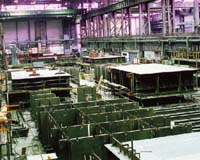
The world may be in recession, but the Russian naval shipbuilding industry is still booming.
RIA Novosti reported Tuesday that naval shipbuilding last year accounted for $7 billion of Russia's record $8.5 billion in arms sales around the world funneled through the state-owned Rosoboronexport arms export corporation.
"This sum relates to the Rosoboronexport portfolio of orders. This is the maritime share of the portfolio of orders," Rostekhnologii First Deputy General Director Alexei Alyoshin told the news agency.
RIA Novosti said Russian arms exports soared in 2008 to $8.5 billion — double the figure of nine years ago. That allowed Russia to shoot ahead of Britain to become the world's second-largest arms exporter after the United States. Rosoboronexport currently has on its books arms exports worth $33 billion, the report said.
Russia currently sells weapons to no less than 80 nations around the world, RIA Novosti said. While sales are slowly growing in Africa and the Middle East, the main success stories are with the major nations of Asia: India, China, Vietnam and Indonesia all are buying large quantities of Russian-built warships and submarines.
RIA Novosti noted that India and China have continued to buy Russian submarines, frigates and destroyers. Vietnam has signed a contract for new Svetlyak-class fast attack boats and frigates, and Indonesia has ordered corvettes from Russia to be built with the help of Spanish shipbuilding companies.
As we have monitored in these columns, India's much-touted strategic relationship with the United States during the eight years of the Bush administration never translated into any significant conventional arms purchases from American companies. This was especially the case with the Indian navy, which showed no interest in receiving the old U.S. aircraft carrier Kitty Hawk in return for agreeing to buy Boeing F/A-18E/F Super Hornet combat aircraft to operate from it.
Instead, the Indians patiently renegotiated their troubled contract with Russia to refurbish the old Soviet-era aircraft carrier Admiral Gorshkov for the Indian navy, even though Russia's Sevmash shipyard was hundreds of millions of dollars and years behind schedule on the project.
Russia remains reluctant to sell state-of-the-art ground forces weaponry, transportation systems and tactical close air support weapons to China, a reluctance that has put a serious strain on Sino-Russian relations in recent years. However, this reluctance has not translated into selling to Beijing warships, Kilo-class diesel submarines and lethal Mach 2.8 state-of-the-art sea-hugging anti-ship cruise missiles that could devastate U.S. nuclear-powered aircraft carriers.
Meanwhile, Rosoboronexport officials remain optimistic about their sales prospects, even in the current troubled global economic climate. They project their foreign weapons exports to soar by no less than 8 percent to 10 percent per year over the next three to four years, RIA Novosti said.
Russia's arms export successes certainly have not been limited to naval surface warships and submarines. RIA Novosti also noted that Sukhoi and Mikoyan-Gurevich MiG combat aircraft, air defense systems, helicopters, battle tanks, armored personnel carriers and infantry fighting vehicles have all proved popular, highly successful export items.
Share This Article With Planet Earth
