
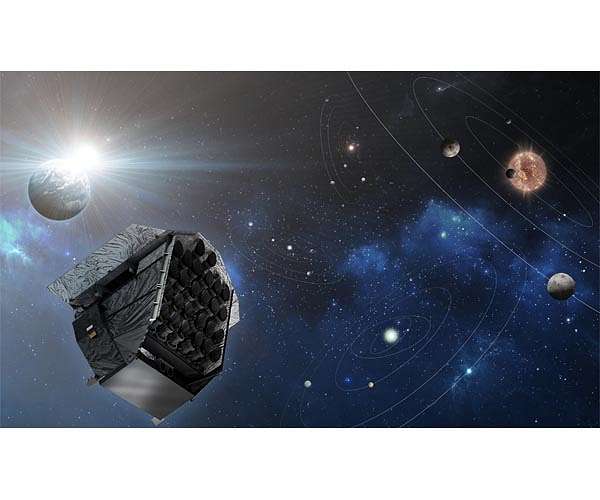
The "planet-hunting" mission PLATO (PLAnetary Transits and Oscillations of stars) of the European Space Agency (ESA) is a space-based observatory to find and study extrasolar planetary systems with emphasis on the properties of terrestrial planets in the habitable zone around solar-like stars.
It is scheduled to launch in 2026. Mid-January RUAG Space, a leading supplier to the space industry, and OHB, Germany's first listed space and technology company, signed the contract for the Sunshield Solar Array Subsystem.
The contract is worth more than 20 million Swiss Francs. RUAG Space will provide mechanisms, structures (panels) as well as thermal insulation, a transport container and other ground support equipment. A solar array consists of several solar panels that generate electricity for the satellite. The solar array also shields the 26 cameras and electronic units of the PLATO observatory from the sunlight.
Complete subsystem from a single source
"Our customer receives a complete subsystem from us from a single source. By this, our customer saves a lot of time and efforts. Our goal is to simplify our customers' supply chain and make their lives easier," says Oliver Schiewe, Senior Vice President Spacecraft at RUAG Space.
"For RUAG Space providing subsystems is an important strategic step to deliver added value for a strongly changing space market." The customer also profits from a reduction of interfaces, adds Oliver Kunz, General Manager Mechanisms at RUAG Space.
The delivery of the hardware to OHB in Bremen, Germany, is scheduled for summer 2024. "We selected RUAG Space for this subsystem since they have best competences in design and development of highly complex mechanical, thermal and mechanism solutions.
"In addition, we are well acquainted with RUAG's cooperative approach and fully confident to establish an effective working relationship for the success of our PLATO project," says Wolfgang Paetsch, Board Member of OHB System AG.
