
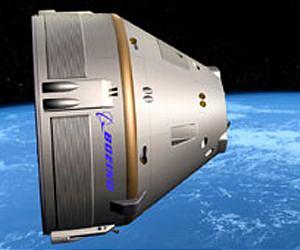
Pratt and Whitney Rocketdyne has completed a series of hot-fire tests on a service module thruster for Boeing's Commercial Space Transportation (CST)-100 spacecraft. The CST-100 spacecraft, designed to transport people to the International Space Station and other low-Earth orbit destinations, is in development under NASA's Commercial Crew Program.
The Orbital Maneuvering and Attitude Control System (OMAC) thruster is a key component for safe, reliable and affordable commercial crew transportation. It is designed for multiple uses, including maneuvering the CST-100 spacecraft during orbit and re-entry, and providing axial thrust, roll control and separation from the launch vehicle if an abort becomes necessary.
"The 1,500-pound force thrust class engine achieved full thrust while validating key operating conditions," said Terry Lorier, Pratt and Whitney Rocketdyne's Commercial Crew Development program manager, supporting Boeing's program. "We're excited about the performance of the engine during the testing, and are confident the OMAC thrusters will affordably meet operational needs for safe, reliable human spaceflight."
OMAC tests verified thermal characteristics and durability of the thruster; evaluated valve operation; and confirmed combustion stability and performance. The OMAC simulated altitude tests were conducted at NASA White Sands Test Facility in New Mexico.
The CST-100 spacecraft's service module is designed to have 24 OMAC thrusters. Boeing is advancing the design of the CST-100 in Phase 2 of NASA's Commercial Crew Development Program (CCDev-2). CCDev-2 builds upon the successful propulsion system design and hot-fire Bantam demonstration engine tests performed during the first round of CCDev. CCDev-2 enables Boeing to reduce additional component risks and mature its system through preliminary design review.
Under its contract with Boeing, Pratt and Whitney Rocketdyne is leveraging proven Attitude Control Propulsion System thrusters from heritage programs, a low-cost Bantam engine design, and its storable propellant engineering capabilities to partner with Boeing.
