
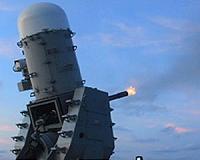
Raytheon has received a $64.6 million contract to perform technical support services for several naval anti-ship weapon systems operated by the U.S. Navy.
The contract covers services for the Phalanx Close-In Weapon System, the SeaRAM, and the Land-based Phalanx Weapon System. Foreign military sales for Saudi Arabia, Taiwan, Canada, Britain, South Korea, Portugal, and Greece are also included in the deal.
The Phalanx Close-In Weapon System, or CIWS, is a fast-reaction defensive weapon designed to protect maritime warfighters against anti-ship missile threats. The systems can operate either autonomously or as part of an integrated combat system.
Work on the contract will be performed in Tucson, Ariz.; El Segundo, Calif., and other locations. The U.S. Department of Defense expects the contract to be complete by January 2018.
The agreement is comprised of options with the potential to raise the contract value to $398 million if exercised. The Naval Sea Systems Command in Washington, D.C., is listed as the contracting activity.
Boeing contracted for Harpoon weapon production
Washington (UPI) Dec 22, 2016 –
Boeing has received a $207 million contract to produce Lot 90 Harpoon weapon systems and spares for the governments of Egypt, Korea, and Brazil.
The contract, which combines U.S. Navy purchases with foreign military sales, also includes components for the governments of Japan, Australia, Thailand, India, Oman, Taiwan, and the United Arab Emirates. Foreign military sales funds totaling $99.6 million were obligated at the time of the contract award.
Work on the contact will be performed in St. Charles, Mo.; McKinney, Texas; Burnley, Britain; and other locations. The U.S. Department of Defense says the contract was not competitively procured, and expects the work to be complete by March 2021.
The Harpoon is an all-weather anti-ship missile typically integrated with naval platforms. The missile uses a radar guidance system to attack surface ships, and can also be launched from submarines, shore batteries, or aircraft.
The weapon was initially developed for the U.S. Navy as a common anti-ship missile for its fleet, but has since been adopted by the U.S. Air Force and various other armed forces around the world.
