
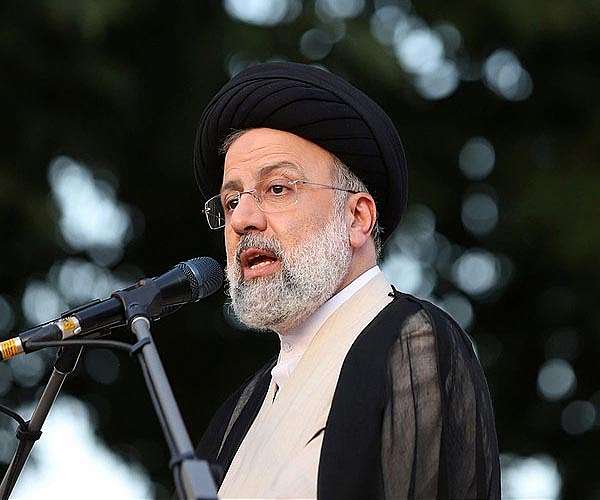
Russian President Vladimir Putin will host his Iranian counterpart Ebrahim Raisi in Moscow on Wednesday, the Kremlin said, amid talks aimed at reviving the Iran nuclear deal.
The meeting will be Raisi's most important official visit abroad since he took office, and the first visit by an Iranian president to Russia since 2017.
The leaders will discuss the "whole range of issues of bilateral cooperation", including the 2015 deal that offered Tehran sanctions relief in exchange for curbs on its nuclear programme, the Kremlin said in a statement.
In 2018, Washington announced its unilateral withdrawal from the agreement under former president Donald Trump, prompting Iran to walk back on its commitments.
Since last year, Iran has been in talks with the signatories of the accord — the United States, France, Britain, Russia, China and Germany — to restore the deal, but negotiations stopped in June after Raisi's election.
They resumed in November.
Russia's foreign minister Sergei Lavrov earlier this month noted "real progress" in the talks.
Moscow and Tehran have strong political, economic and military ties, shared interests in Afghanistan, and are key allies of Syrian President Bashar al-Assad in his country's decade-long civil war.
This will be Raisi's third visit outside Iran — after Tajikistan and neighbouring Turkmenistan — since he took over the presidency in August from moderate Hassan Rouhani.
The Iranian side confirmed the visit, saying Raisi would leave Wednesday for a two-day trip to Russia together with the country's oil, foreign and economy ministers.
A Russian lawmaker told reporters that Raisi would speak at the lower house of parliament, the State Duma, on Thursday, while TASS news agency cited a source as saying he would meet with religious leaders at Moscow's main mosque.
Iran says decision time for US in nuclear talks
Tehran (AFP) Jan 17, 2022 – Iran said Monday it is time for the United States to take political decisions to resolve key remaining issues, including on lifting sanctions, at talks aimed at reviving Tehran's nuclear deal.
"What remains are important and key issues that require specific political decisions," foreign ministry spokesman Saeed Khatibzadeh said at his weekly news conference.
"Washington, in particular, must announce its decisions on removing sanctions and the remaining issues," he said.
"If this happens … we will reach a lasting, reliable agreement at a good pace."
His remarks came on the day chief negotiators were due to return to Vienna for the talks after having travelled home on Saturday for consultations.
Discussions continued over the weekend at the level of experts.
The drive to salvage the 2015 nuclear deal resumed in late November, after talks were suspended in June as Iran elected ultraconservative President Ebrahim Raisi.
The 2015 deal — agreed by Iran, the US, China, Russia, Britain, France and Germany — offered Tehran sanctions relief in exchange for curbs on its nuclear programme.
But the US unilaterally withdrew in 2018 under then-president Donald Trump and reimposed stiff economic sanctions, prompting Tehran to begin rolling back on its commitments.
"Negotiations are going in the right direction, we have no unresolvable impasses," Khatibzadeh said, pointing to consensus over much of the text of a new deal.
Different parties have signalled progress at the talks, with Tehran saying this was due to efforts by "all sides".
But Khatibzadeh criticised delays, "especially by the US", in proposing initiatives for the lifting of sanctions.
The US has participated only indirectly in the talks, which seek to bring Washington back to the accord and to ensure Iran returns to its commitments under the deal.
Western parties have insisted on the "urgency" of reaching a deal, with US Secretary of State Antony Blinken saying on Thursday that there are only weeks left to save the accord.
Washington is ready to look at "other options" if negotiations fail, he said.
In response, Khatibzadeh warned: "Mr Blinken knows better than everyone that every country has its own Plan B and Iran's Plan B might not be in the interest of the US."
