
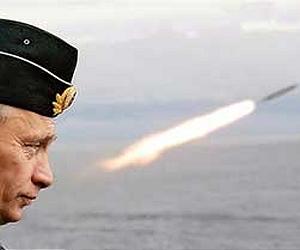
Russia's newly sworn-in President Vladimir Putin Monday was handed the black suitcase Monday that controls the country's vast nuclear arsenal moments after taking his oath to a third term.
With outgoing Kremlin leader Dmitry Medvedev standing at his side, Putin was given command of the "nuclear suitcase" at a formal post-inauguration ceremony overseen by Russian Defence Minister Anatoly Serdyukov, official images showed.
The portable communications device uses a secret code called Cheget to allow the country's commander-in-chief to launch instruction that could potentially trigger a nuclear attack against a foreign country.
Widely seen as a relic of the Cold War standoff between Moscow and Washington, the suitcase remains at the president's side at all times, including on his foreign visits.
First developed in 1983, the system is usually carried by specially assigned officers called "operators" and was first used by former Soviet leader Konstantin Chernenko in 1984.
Although the president's black suitcase is the most famous and symbolic, it is actually one of three operated in Russia on a daily basis.
The other two accompany the army's chief of staff and the defence minister. The strategic command centre must receive a coded signal from each of the devices before it can launch a nuclear attack.
The suitcase left the Kremlin chief on only one occasion in October 1996, when the late premier Viktor Chernomyrdin briefly assumed it from Boris Yeltsin when Russia's first post-Soviet president underwent a heart bypass operation.
Medvedev held on to it for four years after taking over the presidency from Putin, whose first two terms stretched between 2000 and 2008.
