
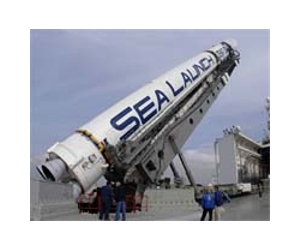
International consortium Sea Launch plans to resume Zenit-3SL carrier rocket launches from its floating platform in the Pacific Ocean in 2011, the head of the Russian Rocket and Space Corporation Energia said Monday.
"All political conditions for resuming launches on the Sea Launch program have been met. All commissions in the United States have been passed. A license for 70 launches has been received," Vitaly Lopota said.
"There are enough contracts for satellite launches. The first launch is due at the end of next year," he told journalists.
Sea Launch was created in 1995. It incorporated Energia with a 25% stake, a Boeing subsidiary with 40%, Norwegian company Aker ASA with a 20% stake and Ukraine's SDO Yuzhnoye/PO Yuzhmash with 15%.
Sea Launch announced its bankruptcy in June 2009. In July 2010, Energia subsidiary Energia Overseas Limited (EOL) received 95% in Sea Launch by a bankruptcy court ruling.
A total of 30 rocket launches have been made from the Pacific platform since 1999, with 27 of them successful.
earlier related report
Globalstar Second-Generation Satellites Integrated Into Soyuz Upper Stage
Baikonur (SPX) Oct 12 – Payload integration for Arianespace's upcoming Soyuz mission is nearly complete, as the dispenser with its six Globalstar satellites has been installed on the launcher's Fregat upper stage at Baikonur Cosmodrome.
The October 19 flight will be performed for Arianespace by its Starsem affiliate, and the integration of the dispenser with its satellite cluster on Fregat was completed yesterday in Starsem's Upper Composite Integration Facility (UCIF) – located at Baikonur Cosmodrome's Site 112 facility.
This step clears the way for the dispenser's encapsulation in the Soyuz ST payload fairing, which is planned for the weekend.
Arianespace has been contracted to perform four Soyuz launches carrying six satellites each – further building Globalstar's constellation with these 24 second-generation spacecraft.
Their deployment will secure the company's space segment beyond 2025, ensuring continuity for its mobile satellite voice and data services provided to businesses, governments and consumers.
Globalstar's second-generation satellites will have a liftoff mass of approximately 700 kg. each, and are fitted with 16 transponders from C- to S-band, along with 16 receivers from L- to C-band.
Arianespace's Globalstar missions will use the Soyuz 2 evolved version of Russia's venerable medium-lift workhorse launcher, which incorporates the enlarged ST payload fairing and an updated digital flight control system.
Soyuz 2 is the same vehicle that Arianespace will utilize at the Spaceport in French Guiana, operating side-by-side with its heavyweight Ariane 5 and Vega lightweight launchers.
These four new missions follow eight flights performed by Starsem from 1999 to 2007 using an earlier Soyuz version to orbit a total of 32 first-generation Globalstar spacecraft. Each of those launches orbited four of the 450-kg. satellites.
Share This Article With Planet Earth
