
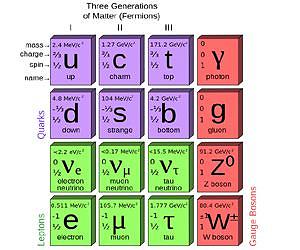
Some people like company. Others prefer to be alone. The same holds true for the particles that constitute the matter around us: Some, called bosons, like to act in unison with others. Others, called fermions, have a mind of their own.
Different as they are, both species can show "collective" behavior – an effect similar to the wave at a baseball game, where all spectators carry out the same motion regardless of whether they like each other.
Scientists generally believed that such collective behavior, while commonplace for bosons, only appeared in fermions moving in unison at very long wavelengths. Now, however, collective behavior has been discovered at short wavelengths in one Fermi system, helium-3.
A team led by Professor Eckhard Krotscheck – a physicist who recently joined the University at Buffalo from the Johannes Kepler University in Linz, Austria – predicted the existence of the behavior using theoretical tools. Independently, but practically at the same time, a French team observed the collective behavior.
A paper detailing both the theoretical and experimental discoveries appears in the journal Nature.
Krotscheck said the scientists' success in developing accurate theoretical predictions lay, in part, in the fact that they focused on mathematical tools instead of trying to reproduce experiments.
"Knowing how nature ticks at a microscopic scale, we set out to develop a robust theory that was capable of dealing with a wide range of situations and systems," Krotscheck said. "We demanded that our mathematical description is accurate for both fermions and bosons, in different dimensions, and for both coherent and incoherent excitations. Only after we were done, we looked at experiments."
