
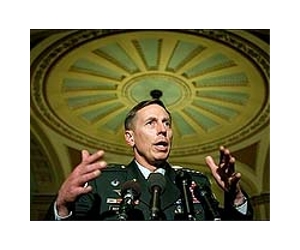
By choosing an architect of the Afghan campaign to take over as commander in Kabul, President Barack Obama on Wednesday signaled his war strategy will not change, even amid troubling signs of potential failure.
General David Petraeus will bring political savvy and a vaunted reputation to the job, but he inherits a mission full of risks for the United States and his own legacy.
"He clearly has the most stature and credibility of any commander in the military," said Richard Fontaine of the Center for a New American Security.
"That goes a long way, but you also have to deal with the expectations that accompany it," he told AFP.
Petraeus, renowned for his role in the Iraq war, offers Obama the prospect of a smooth transition at the helm in Afghanistan, after General Stanley McChrystal was forced to step down for disparaging remarks about the administration.
As head of the regional Central Command, Petraeus has been deeply involved in shaping the war effort in Afghanistan and Obama made clear his decision marked a change in personnel but "not a change in policy."
Although Petraeus enjoys a near rock star status among troops and in Washington for his role in the Iraq war, the task in Afghanistan is daunting and time is short.
Obama has promised a gradual withdrawal of US troops will begin by July 2011, even though a surge of 30,000 troops will not be complete until September.
In Iraq in 2007, Petraeus had about nine months to show some progress in the war. In Afghanistan, he has much less time, as the White House plans an assessment of the war by December.
"There's not a huge amount of time on the Washington clock," Fontaine said.
Petraeus will be under intense pressure to show progress quickly, at a time of rising casualties and mounting anxiety in Congress that the war against the Taliban could be a fruitless quagmire.
In recent weeks, military officers acknowledged the outcome of a much-touted offensive in Helmand province has proved disappointing, while a pivotal operation in Kandahar has had to be postponed.
In testimony before Congress last week, Petraeus suggested the 2011 target date would not trigger any major pullout, implying a large US force could remain for several years.
He said mid-2011 "is not the date when we look for the door and try to turn off the light, but rather a date at which a process begins."
Afghan President Hamid Karzai's corruption-tainted government meanwhile threatens to undermine any military progress on the ground.
"Our biggest problem in Afghanistan is the government we are supporting there, and it isn't clear to me what Petraeus can do about that," author and journalist Thomas Ricks wrote on his Best Defense blog.
At Kabul headquarters overseeing the NATO-led force, Petraeus will quickly face a crucial decision as to when to launch larger-scale operations around Kandahar, the birthplace of the Taliban.
"I think Kandahar is the crux of it," said Michel O'Hanlon of the Brookings Institution.
Analysts say Petraeus will also have to decide the pace of training for Afghan security forces, considered vital to any eventual exit for US and coalition troops.
He will have to balance the need to rapidly expand the Afghan forces while ensuring the soldiers and police can hold their own in combat, a problem that initially undermined similar US efforts in Iraq.
Obama is also banking on Petraeus' political skills and experience to help repair broken relations with the military's civilian counterparts in the State Department and White House, which had become toxic under McChrystal, Fontaine said.
"On the civilian side, I do think you have at least the potential for an improvement in the civilian military ties," he said, citing Petraeus' cooperation in Iraq with the US ambassador at the time.
At the senate hearing last week, Petraeus tried to reassure lawmakers that the outlook in Afghanistan was not as bleak as some media reports indicated, but appealed for patience.
"The conduct of a counterinsurgency operation is a roller-coaster experience. There are setbacks as well as areas of progress or successes." Petraeus said.
"But their trajectory, in my view, has generally been upward, despite the tough losses, despite the setbacks."
earlier related report
Obama dumps McChrystal over magazine tirade
Washington (AFP) June 23, 2010 –
President Barack Obama Wednesday fired Afghan war commander General Stanley McChrystal, stamping his authority on the military and warning he would not tolerate petty divisions over US strategy.
Obama replaced McChrystal with David Petraeus, the talismanic general who rescued a losing war in Iraq, and who will now be asked to turn around a bloody nine-year conflict on which the commander-in-chief has staked his presidency.
"War is bigger than any one man or woman, whether a private, a general or a president," Obama said, after sacking McChrystal for mocking senior political leaders in a magazine interview.
The president said his hand was forced by a need to ensure the integrity of civilian control over the military and preserve trust among members of his war cabinet as the interminable conflict grinds on.
McChrystal's swift fall from grace came despite expressions of support from Europe and the Afghan government of President Hamid Karzai.
The furor over the damaging remarks by the general and his staff focused a harsh spotlight on Obama's troop surge strategy as the war reaps an ever bloodier toll and public support for the conflict plummets.
Obama praised his four star general's "remarkable" career, before bluntly saying: "The conduct represented in the recently published article does not meet the standard that should be set by a commanding general."
McChrystal was ordered back to the White House to be fired, and spent a half hour with Obama, while turning in his resignation.
The president then went into a meeting with senior national security subordinates, and read them the riot act on the war.
"I would describe the president's remarks as stern," a senior administration official said on condition of anonymity. "His overall message was that we have to remember why we are doing this… he did not want to see pettiness."
Obama said unity was vital, as thousands of extra American troops pour into Afghanistan in an effort to finally beat the Taliban and bring stability to a nation hammered by decades of war.
"I've just told my national security team that now is the time for all of us to come together. I welcome debate among my team, but I won't tolerate division."
In a conspicuous show of unity, Obama was surrounded in the White House Rose Garden by Petraeus, Biden, chairman of the joint chiefs of staff Mike Mullen and Defense Secretary Robert Gates.
Petraeus, who saved a failing US mission in Iraq, will step aside as the commander of US forces in the Middle East to take over the faltering NATO-led campaign in Afghanistan.
McChrystal was contrite in a statement issued after he spoke to Obama.
"I strongly support the president's strategy in Afghanistan and am deeply committed to our coalition forces, our partner nations, and the Afghan people," he said.
"It was out of respect for this commitment — and a desire to see the mission succeed — that I tendered my resignation."
British Lieutenant General Nick Parker has taken interim command of NATO's Afghan forces in McChrystal's absence, Downing Street and White House officials said.
Some NATO nations with troops in the US-led Afghan force fretted that the episode sent an unwelcome signal to US enemies.
German Defence Minister Karl-Theodor zu Guttenberg told German television that NATO forces were facing a "very tough summer" and that the alliance needed steady leadership.
In Kabul, Waheed Omar, a spokesman for Afghan President Hamid Karzai, said his boss respected the decision and praised the choice of Petraeus, who must be confirmed by the US Senate.
"General David Petraeus is someone who knows Afghanistan, who knows the region very well and is an experienced general," Omar told AFP.
The uproar comes at a pivotal moment in the Afghan war with US lawmakers increasingly anxious that the mission is failing amid delays in a make-or-break offensive to drive the Taliban out of their Kandahar stronghold.
The clock is also ticking on a White House deadline to start withdrawing some US troops by July 2011, and Obama had been under pressure from certain quarters to keep McChrystal so as not to throw this timeline off course.
In Rolling Stone's profile, titled "The Runaway General," McChrystal aides mocked Biden, dismissed Obama's national security adviser as "a clown," and revealed that McChrystal was "disappointed" by his first meeting with Obama.
Share This Article With Planet Earth
