
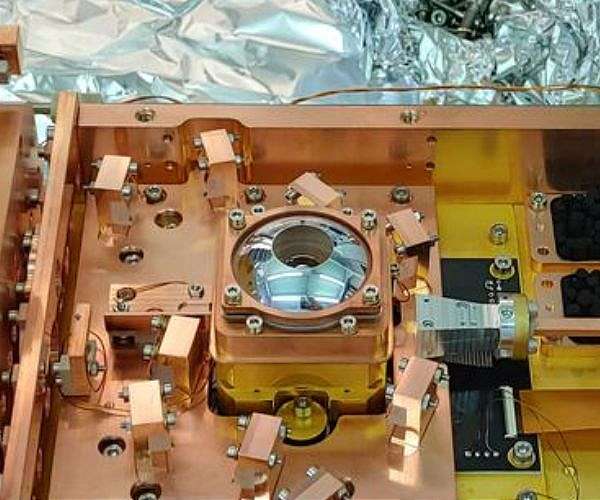
Researchers at ETH Zurich, led by Jonathan Home, have significantly advanced the field of quantum computing by demonstrating the feasibility of constructing ion traps using static magnetic fields, thereby overcoming the limitations of traditional oscillating electromagnetic fields. This innovative approach, utilizing Penning traps, enables more extensive quantum computers by allowing for arbitrary ion transport and the execution of complex operations necessary for next-generation quantum computing, as detailed in their recent publication in Nature.
Quantum bits, or qubits, are the fundamental units of quantum computers, requiring precise control over the quantized energy states of electrons in atoms. Traditional quantum computing methods have relied on Paul traps, utilizing oscillating electromagnetic fields to trap ionized atoms. However, this method presents significant challenges for scaling up, as it complicates the integration of multiple traps on a single chip and generates heat that adversely affects the system's performance.
The team's innovative use of Penning traps, which employ static magnetic fields, marks a significant departure from conventional methods. Penning traps have historically been favored for trapping large numbers of ions for precision experiments without needing individual control. The ETH Zurich team's adaptation of this technology for quantum computing purposes addresses the scalability and operational challenges associated with Paul traps.
"Traditionally, Penning traps are used when one wants to trap very many ions for precision experiments, but without having to control them individually," explains PhD student Shreyans Jain. "By contrast, in the smaller quantum computers based on ions, Paul traps are used."
Despite initial skepticism due to the high costs and physical bulk of the strong magnets required for Penning traps, as well as the technical complexities introduced by the need for multiple phase-locked lasers instead of a simple diode laser, the researchers successfully demonstrated a microfabricated Penning trap. This trap, created in collaboration with the Physikalisch-Technische Bundesanstalt in Braunschweig, utilizes a superconducting magnet producing a 3 Tesla magnetic field, facilitating the arbitrary movement of trapped ions across the chip without the need for oscillating fields.
Furthermore, the team achieved coherent control of the qubit energy states, maintaining quantum mechanical superpositions essential for quantum computing. "Once they are charged up, we can even completely isolate the electrodes from the outside world and thus investigate how strongly the ions are disturbed by external influences," adds PhD student Tobias Sagesser.
Looking ahead, the researchers aim to trap two ions in neighboring Penning traps on the same chip, proving the viability of Penning traps for multi-qubit quantum operations. This breakthrough not only paves the way for scalable quantum computing but also opens new avenues for using these systems as atomic sensors for probing surface properties.
Research Report:Penning micro-trap for quantum computing
