
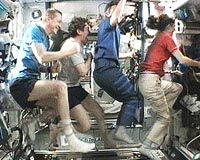
We've studied the human body in weightlessness for decades, and we now have a fairly good understanding of how it affects us. It's important to know this. Weightlessness, or microgravity, can seriously influence the health and performance of astronauts.
One thing we don't properly understand, though, is the influence of partial gravity on the human body. This will need to be studied more thoroughly if we plan to support a long-term human presence on the Moon and Mars.
So far, our only experiences with partial gravity have been limited to the dozen astronauts who walked on the Moon. Partial gravity was probably more of a blessing than a problem to these astronauts.
It allowed things to stay put and fall down, a useful condition when going to the toilet. This author once asked Buzz Aldrin if he noticed any odd effects from exposure to partial gravity during his historic Moonwalk. He didn't. Other astronauts seem to have experienced no bad influences from the one-sixth normal gravity, apart from its strange effects on walking in a bulky spacesuit.
The Apollo missions were short, and the maximum exposure to partial gravity was only three days. It's understandable that partial gravity created no physiological problems for these astronauts. Living on a Moonbase will be different. Astronauts will experience partial gravity for weeks or months.
What will happen to a person in low gravity for a long time? It's possible that some of the effects will resemble those of long-term weightlessness, but with reduced intensity. Muscles will not be placed under much strain, and will weaken. Bones may suffer calcium loss. The immune system could be compromised.
Exercise will probably counteract most of these problems. Some possible issues may never appear at all. We may find that even a little gravity is enough to cancel some of the more serious issues of weightlessness.
Partial gravity is certainly an issue in spaceflight, but it will probably be one of the least serious problems to confront astronauts on deep space missions. It will certainly be more benign than weightlessness, and we have managed to deal with that on long orbital missions.
It's been suggested that we could mimic the conditions of partial gravity using centrifuges in orbit. Some could be large enough to hold humans. This is an interesting way of studying the issue, but the rotation introduces further complications. We may not be able to determine how an effect observed in a centrifuge will translate into those produced genuine gravity.
Share This Article With Planet Earth
