
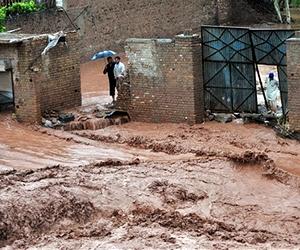
Villagers shifted debris with their bare hands Wednesday, clawing at mud to retrieve belongings as waters started to recede in one of the worst-hit areas of Pakistan's devastating floods.
The village of Gulabad, on the outskirts of the northwestern town of Charsadda, once had 500 houses. It is now totally destroyed.
Its collection of mud brick and concrete homes has been reduced to rubble, washed away or buried under a heap of mud, sand and silt.
One man tried to recover his refrigerator. Another emerged from crumbling masonry with a table fan. Both were drenched in thick mud. A small boy rushed towards family members showing off a simple tray he picked out from the rubble.
Most homes were still under the water and uninhabitable. Residents erected tents or strung beds alongside the roadside, sleeping under the open skies that threaten to dump further rain in the coming days, an AFP reporter said.
Survivors lashed out at what they branded government apathy and heaped abuse on a civilian leadership already straining to contain Taliban and Al-Qaeda linked violence, and the worst targeted killings in years in Karachi.
"They're shameless. They have no care or love for the people. We're alive because of self-help and support from the public," said Sher Dad, a retired soldier in the army, which has ruled Pakistan for more than half its existence.
"It's almost been a week and we have no aid. No rescue team came and no relief has been distributed," he added.
Rooms were filled with silt and mud from the river water that overflowed when the floods unleashed havoc, said 27-year-old labourer Sudher Ahmed.
"Government supplies are given to political people who distribute it among their relatives and supporters. Ordinary people are not getting their share.
"We are surviving because of the food and water we get from philanthropists. We often see helicopters flying overhead but never land in our area," he said.
As he talked, a man arrived in a truck with huge buckets of cooked food, slabs of ice and cold drinking water. Without introducing himself, he started distributing it among the affected families.
Earlier, another vehicle had driven up bringing food donations from teachers at the University of Peshawar, the main northwestern city.
People gathered on a roadside where the water levels had receded, stacking up household items, and quilts, blankets and rugs on to folding beds.
A cage with dead partridges lay next to an overloaded van ready to transport people to safer havens, with at least 30 people clinging to its roof.
A local philanthropist has converted his privately-run school into a relief centre where workers unloaded food items donated by the United States.
Share This Article With Planet Earth
