
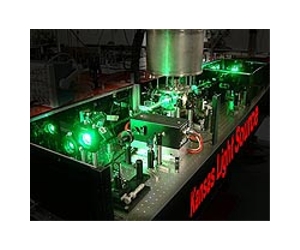
Ultrafast lasers, lasers that emit light pulses that are as short as a few femtoseconds, have enabled a wide-range of fundamental science and applications over the past two decades.
To highlight recent state-of-the-art developments in femtosecond lasers, the Optical Society (OSA) published a series of papers as part of an upcoming special Focus Issue on Modular Ultrafast Lasers in its open-access journal Optics Express.
The issue is organized and edited by Wilson Sibbett and Tom Brown of the University of St Andrews in the United Kingdom, and focuses on developments based on solid-state, semiconductor and fiber lasers.
The demonstration of Kerr-lens mode locking, a paradigm shifting approach to generating ultrashort pulses first reported in 1990, signified the beginning of the era of practical femtosecond lasers that opened up a greatly enlarged range of applications. Today, the many different types of femtosecond lasers exhibit a wide variety of operating properties and complement each other well.
While many current user requirements are covered, there are significant applications for which they are either not sufficiently well developed or inadequately adapted. By taking a modular approach, it is now possible to target and combine the strengths of different laser types to facilitate a push toward a truly flexible ultrafast laser platform that is amendable to external electronic control.
Ultrafast lasers have uses in a wide range of fields, including biology and medicine, chemistry, telecommunications, manufacturing and energy research. For example, ultrafast lasers are used for drilling and cutting high-precision holes such as in medical stents; ophthalmologic procedures such as corneal surgery; and medical imaging.
"Research and applications of ultrafast lasers has been expanding in recent years, producing a range of exciting developments from fundamental science to advanced laser eye surgery," said Brown.
"The next generation of femtosecond lasers is likely to continue to impact a broad range of science and technology that will rely on user-specified outputs. Our goal in organizing this focus issue is to highlight the overall field of practical ultrafast lasers and how it has continued to develop strongly with a diverse and versatile range of ultrafast source options."
