
For newly hatched and juvenile fish, the open ocean can be a harsh environment.
Upon hatching, young fish find themselves in a bewildering expanse of blue, filled with strong currents and predators, and with no place to hide. Until now, scientists weren't sure how young fish survive.
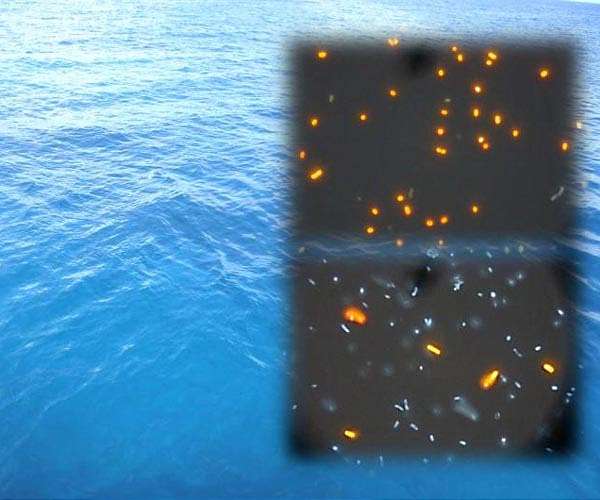
But new research, published Thursday in the journal Scientific Reports, suggests lengthy stretches of calm, glassy water — features called "surface slicks" — serve as nurseries for dozens of fish species, many of them commercially and ecologically vital.
In surface slicks found on the leeward side of the Hawaiian Islands, researchers found more than 100 species of juvenile fish, including mahi-mahi, jacks and billfish.
Previously, scientists relied exclusively on satellite images and ocean models to map the formation of surface slicks, but aerial and digital surveys can only tell scientists so much about what's happening just beneath the ocean surface.
To improve their understanding of surface slicks, scientists combined their novel satellite mapping technology with field observations.
In addition to measuring water conditions inside and outside of the slick, researchers used nets to study the populations of algae and plankton found inside the surface slicks. The nets also captured the larvae of dozens of fish species.
Within a 380-square-mile-study area, researchers found surface slicks made up just 8 percent of the ocean surface, but 39 percent of the surface-dwelling larval fish collected by the survey nets were captured inside surface slicks.
More than a quarter of the zooplankton and 75 percent of floating organic debris was found inside surface slicks.
Analysis of the collected larvae revealed the presence of 112 species of commercially and ecologically important fishes. The survey revealed the presence of reef fish, including jacks, and triggerfish, as well as predators like mahi mahi.
Scientists even found larval lanternfish, a deep sea species, as well shrimps, crabs and other small invertebrates.
"We were shocked to find larvae of so many species, and even entire families of fishes, that were only found in surface slicks," lead study author Jonathan Whitney said in a news release.
"The fact that surface slicks host such a large proportion of larvae, along with the resources they need to survive, tells us they are critical for the replenishment of adult fish populations," said Whitney, a research marine ecologist for NOAA.
The latest findings suggest surface slicks play an important role in shepherding the next generation of the predators and prey that populate coral reefs, and serve as a link between coastal and open ocean ecosystems.
"Our findings are part of an important story forming around the role of biological surface slicks in maintaining coral reefs," said co-author Greg Asner.
"The sheer biodiversity and biomass of the slicks, combined with their oceanic movement along the shore, form a superhighway for species that connects and effectively generates an interconnected, regional reef ecosystem," said Asner, director of the Arizona State University Center for Global Discovery and Conservation Science.
Unfortunately, the calm waters found in surface slicks aren't just a magnet for marine life, but also for plastic pollution. Roughly 95 percent of the plastic debris collected by survey nets was pulled from surface slicks.
Previous studies have shown some marine species utilize plastic debris for shelter, but the benefits are outweighed by risks of accidental ingestion and exposure to toxins.
The researchers said they hope their study will serve as a reminder of the outsized importance seemingly inconspicuous ocean features can play in the sustenance of biologically diverse ecosystems.
