
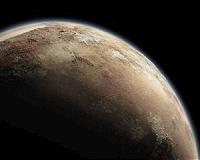
With less than a fifth of the Moon's mass, Pluto can still retain an atmosphere, though a tenuous envelope of gas produced by the periodical sublimation of nitrogen ices. A study that followed the evolution of Pluto's atmosphere for fourteen years shows its seasonal nature, and predicts that it will now start to condensate as frost.
This study1 was published in the journal Astronomy and Astrophysics and had the participation of Pedro Machado, of Instituto de Astrofisica e Ciencias do Espaco (IA2) and Faculdade de Ciencias da Universidade de Lisboa (FCUL).
The authors analysed data from this dwarf planet's atmosphere in the altitude range of 5 to 380 kilometres, collected between 2002 and 2016. This period overlapped with the Summer in Pluto's northern hemisphere3, where are mostly concentrated the reservoirs of nitrogen ice, which sublimate under the exposure and the proximity to the Sun.
Data indicate that the atmospheric pressure at the surface has risen by about twofold and a half since 1988 until its maximum in 2015, yet still one hundred thousand times thinner than the average atmospheric pressure on Earth at sea-level.
"More and more we look at Pluto's seasonal atmosphere as a cometary activity," says Pedro Machado.
"Since it is a body of small mass, nitrogen molecules gain the escape velocity very easily, and Pluto looses atmosphere, like the comets. What will happen now is that temperatures are dropping and the nitrogen molecules are again forming ice crystals near the surface," Machado adds, "in a process similar to water frost here on Earth."
Data came from observations of eleven times Pluto has passed in front of stars in the sky. On this occasions, the light from the star, though hidden from the Earth by the solid body, is bent by the atmosphere to our line of sight.
This technique, know as stellar occultation, enables the use of the light of the star, which passed through the atmosphere, to infer its properties. For instance, light is deflected to a greater or lesser degree depending on the density at different altitudes, allowing to determine the variation of pressure and temperature with the distance from the ground.
Pedro Machado's team provided two observations conducted from the observatory at Constancia Ciencia Viva Science Centre, and also with their experience in the processing and analysis of the data. "Our group of observing of stellar occultations has nearly six years of activity. We belong to an international network and receive international alerts whenever there are occultations visible from Portugal."
The second author of the paper published, Bruno Sicardy, is supervisor, at the Paris Observatory, of PhD student Joana Oliveira, member of IA's Solar System research group. Joana Oliveira is applying the method of stellar occultations to the study of Triton, one of Neptune's moons.
Another member of the group, Joao Ferreira, at the Nice Observatory and co-supervised by Pedro Machado, is using data of stellar positions published by the GAIA4 mission, of ESA, to increase the accuracy in the prediction of future stellar occultations.
Pedro Machado underlines the link between this area and the study of exoplanets. "We are actually learning hands-on a technique similar to the one used to detect and characterise the atmosphere of exoplanets. There's a direct synergy between the research we are doing in the Solar System and the work that IA is doing, or will do, for instance, with the future Ariel5 mission, of ESA, a mission in which we lead one of the goals, one that stands precisely on that synergy."
