
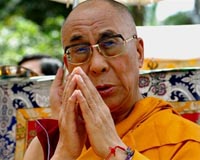
President Barack Obama will meet the Dalai Lama at the White House on Wednesday, in a move likely to enrage China, which sees the exiled Tibetan spiritual leader as a separatist.
Obama's official schedule indicated that the pair, who have met several times previously, would talk behind closed doors in the Map Room at 10:15 am (1415 GMT).
The president usually speaks with dignitaries in the Oval Office. Previous encounters with the Dalai Lama have also been private and held outside the Oval Office to avoid risking relations with China.
Ahead of a February 2014 meeting, US officials at the time said the visit was arranged because the Dalai Lama is "an internationally respected religious and cultural leader" — implying the face-to-face wasn't political.
Beijing has routinely accused Washington of meddling in its domestic affairs after such encounters.
China says the Dalai Lama is seeking to split Tibet from the rest of China and calls him a "wolf in sheep's clothing." But the spiritual leader has pressed more for Tibetan autonomy rather than outright independence.
Many Tibetans say China is repressing their Buddhist religion and culture, and preventing them from benefiting from the region's economic development.
Beijing vigorously lobbies against foreign leaders meeting the Dalai Lama "in any form."
Although Wednesday's meeting will certainly draw China's ire, the concrete consequences remain unclear.
Obama and the Dalai Lama — both Nobel peace laureates — appeared in public together for the first time last year at a high-profile prayer breakfast in Washington.
The president called the spiritual leader "a good friend" and described him as "a powerful example of what it means to practice compassion."
The Dalai Lama has lived in exile in India since 1959 after a failed uprising in Tibet.
Last month, he warned of a growing divide among exiled Tibetans, saying morals are "degenerating" in the community, as the leader of its government-in-exile was sworn in at a ceremony in India.
The spiritual leader called on Tibetans to uphold traditions of love and compassion.
The recent race for political office, won by incumbent Lobsang Sangay, a 48-year-old Harvard scholar, was hit by reports of negative campaigning by candidates.
China rights lawyer ready for consequences over new book: daughter
Hong Kong (AFP) June 14, 2016 –
A leading dissident lawyer in China is prepared to face the consequences over his new book predicting the possible collapse of the ruling Communist Party, his tearful daughter said Tuesday.
Gao Zhisheng has been under house arrest since 2014 after serving a three-year prison term on subversion-related charges — a sentence which sparked an international outcry.
Daughter Grace Gao said the 52-year-old was about to publish a book written in custody and was ready to accept the consequences.
"He told us we (the family) should be prepared. To him he is physically and mentally prepared," the 23-year-old told a press conference.
Gao has indicated he is determined to sacrifice his freedom despite being separated from his family, she said, bursting into tears.
"He's determined he is not going to leave China… for things he thinks are right to do," Grace Gao said.
"He is putting his family aside… he thinks there are things bigger than ourselves."
Gao's wife Geng He fled to the United States in 2009 with Grace and their other child.
The wide-ranging book discusses the physical abuse Gao endured under detention, his faith in God and his belief that the Communist Party could collapse next year.
It has been brought out by a Taiwanese publisher and will go on sale there this week. But the publisher is still looking for a distributor in Hong Kong, said pro-democracy lawmaker Albert Ho.
The dissident lives in an isolated village in Shaanxi province. Ho, a friend of Gao, would not say how the manuscript was delivered to the publisher.
Gao fell foul of Chinese authorities by championing the rights of vulnerable people including underground Christians, aggrieved miners and members of the banned Falungong spiritual movement.
He was convicted in 2006 of "subversion of state power" and given a three-year suspended prison sentence.
State media said in 2011 that he had been ordered to serve the sentence after a Beijing court ruled he had violated the terms of his probation.
The decision was criticised by the United Nations, the United States, the European Union and rights groups such as Amnesty International.
Upon his 2014 release, his family said he had suffered abuse in prison and malnutrition that led to severe tooth damage.
Grace said her father was still living in "difficult" conditions and not receiving proper care.
China imprisons a number of high-profile critics including Liu Xiaobo, the writer and democracy advocate who won the Nobel Peace Prize in 2010.
