
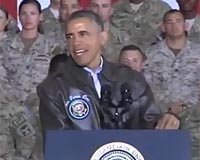
US President Barack Obama called on Congress Thursday to approve $500 million to train and equip vetted Syrian rebels, in what would be a significant escalation of US involvement in the conflict.
Following several signals in recent weeks by the Obama administration — and months of pressure from lawmakers like Senator John McCain — the White House said it intends to "ramp up US support to the moderate Syrian opposition."
It proposed the funding for "vetted elements of the Syrian armed opposition to help defend the Syrian people, stabilize areas under opposition control, facilitate the provision of essential services, counter terrorist threats, and promote conditions for a negotiated settlement."
The proposal was part of the $65.8 billion overseas contingency operations request to Congress for fiscal year 2015, which begins October 1.
In a separate statement, National Security Council spokeswoman Caitlin Hayden said the funding "would build on the administration's longstanding efforts to empower the moderate Syrian opposition" and allow the Pentagon to increase its support to vetted armed rebels.
Washington has been studying options for providing additional assistance to rebel forces beyond the existing aid, which includes mainly "non-lethal" support.
While US officials normally publicly refuse to comment on exactly what they are doing to train opposition groups, Obama's National Security Advisor Susan Rice acknowledged early this month that the Pentagon was aiding Syrian rebels with "lethal and non-lethal support."
About $287 million in mainly non-lethal support has been cleared for the rebels since March 2011, and the CIA has participated in a secret military training program in neighboring Jordan for the moderate opposition.
The request comes at an extraordinarily sensitive time in the Middle East, with Sunni ISIL jihadists in Iraq who are threatening to overtake Baghdad joining forces with extremists in Syria.
Rights observers have said members of Al-Qaeda's franchise in Syria, Al-Nusra Front, pledged loyalty to the Islamic State of Iraq and the Levant (ISIL), giving it control over both sides of the frontier.
The $500 million in aid is part of a proposed $1.5 billion "regional stabilization initiative" to bolster stability in Syrian neighbors Jordan, Lebanon, Turkey and Iraq, and to support communities hosting refugees.
Hayden said US officials "continue to believe that there is no military solution to this crisis and that the United States should not put American troops into combat in Syria."
But she stressed that the request for the rebels would help Syrians "push back against the growing number of extremists like ISIL, who find safe-haven in the chaos, and take their future into their own hands by enhancing security and stability at local levels."
Senator Carl Levin, chairman of the powerful Armed Services Committee, said a similar funding request in the defense authorization bill received broad bipartisan support in his committee.
"In light of recent events in Iraq and Syria, this is appropriate spending," Levin said.
Syria not the answer to Iraq turmoil: US
Washington (AFP) June 26, 2014 –
The United States said Thursday it opposed a role by Syria in resolving Iraq's turmoil after President Bashar al-Assad's government was said to have carried out air strikes against militants.
Iraqi Prime Minister Nuri al-Maliki, facing Sunni extremists who have swept across his country from war-torn Syria, told the BBC that Assad's air force this week struck the insurgents on the Syrian side of the border, in a marked escalation.
State Department spokeswoman Marie Harf, while not confirming the air strikes, said that the United States believed military action by Assad would not be "in any way helpful to Iraq's security."
"Iraq's security situation cannot and should not be resolved by the Assad regime, by air strikes from the Assad regime or by militias funded and supported by other countries in the region stepping in," Harf told reporters.
US President Barack Obama, who opposed the 2003 invasion of Iraq, has offered 300 military advisers to help push back the extremist forces but has opposed a wider involvement and blamed Maliki for alienating minorities.
Obama has also resisted calls for intervention in Syria against Assad, who has ruthlessly put down a rebellion waged by both hardline and moderate Sunni rebels.
The chaos comes as the Obama administration explores repairing ties with Iran, a Shiite clerical state that has staunchly supported both Maliki, a fellow Shiite, and Assad, a secular leader from the heterodox Alawite sect.
Harf said that Iran, unlike Syria, "could play a constructive role" in Iraq if it "did things to promote an inclusive government" and did not promote a sectarian Shiite agenda.
Secretary of State John Kerry heads Friday for consultations with US ally Saudi Arabia, a conservative Sunni monarchy which is strongly critical of both Assad and Maliki.
