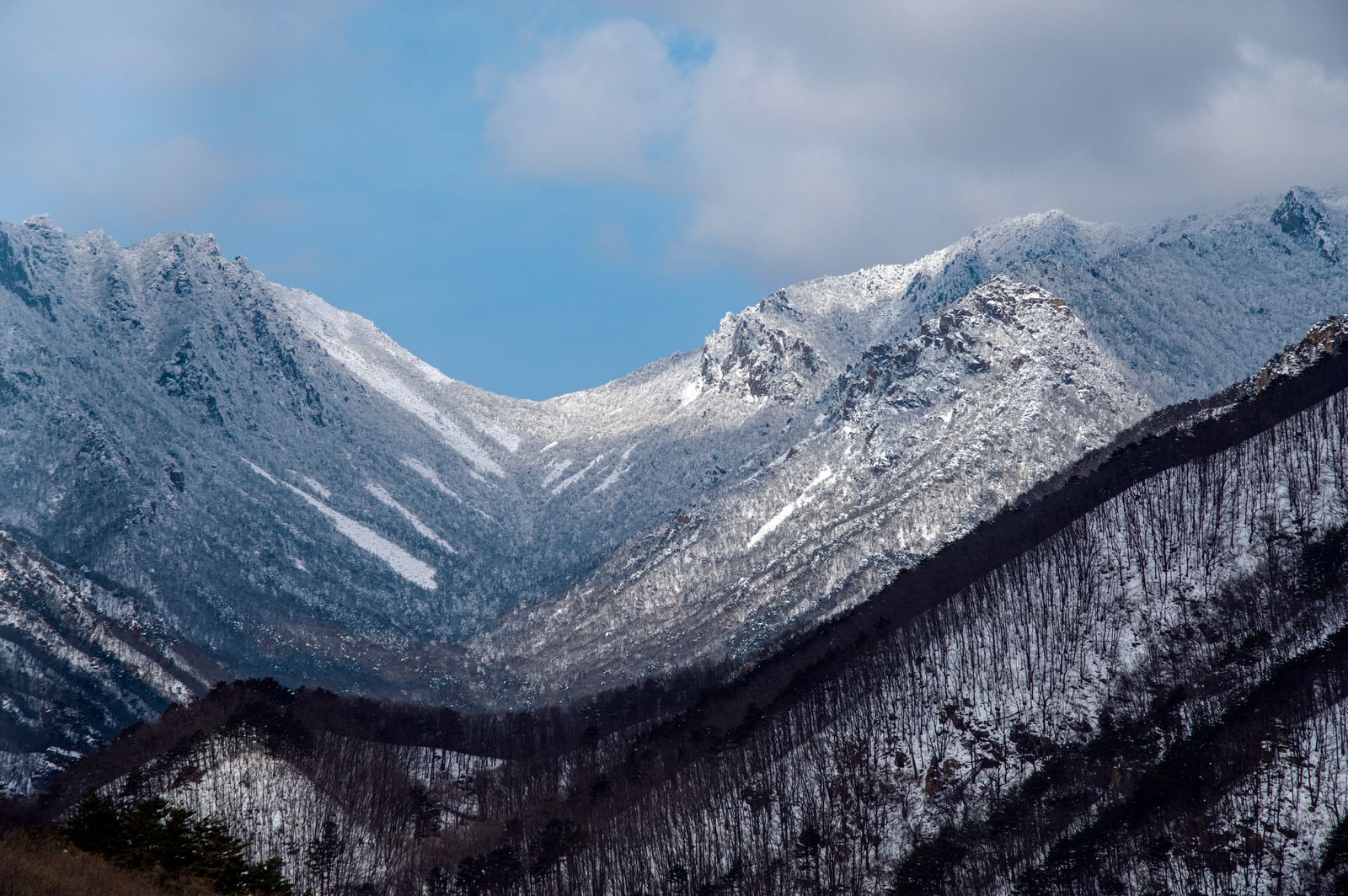
South Korea’s mountains returned because its government treated deforestation as an energy problem, not simply as a shortage of trees. Beginning in the late 1950s, officials moved households away from firewood and toward yeontan, perforated briquettes made from domestic anthracite coal, while restricting wood collection and launching national forest rehabilitation plans that restored about 1.08 million hectares by 1978 and another 0.97 million hectares by 1987. By the time the country’s first commercial nuclear reactor entered service in 1978, the forest recovery was already under way and rural electrification was nearing completion. The sequence was wood, briquettes, electricity and then an increasingly nuclear-powered national grid.
The briquette did not regrow the forests by itself. Its importance was that it gave millions of households something else to burn while planted slopes, damaged soils and exhausted root systems were given time to recover.
South Korea’s forests now cover about 63 percent of the country. The Korea Forest Service estimates that average growing stock rose from 5.7 cubic metres per hectare in 1953 to 165 cubic metres per hectare in 2020, a 29-fold increase that measures something forest-cover maps alone cannot show: the bare and thinly wooded hills became dense forests again.
The hills that had become household fuel
The landscape inherited by South Korea after the Korean War was not merely short of mature timber. Colonial-era cutting, wartime destruction, farming on steep slopes and desperate fuel gathering had left large areas with little more than scrub, exposed soil and scattered trees.
Wood was the fuel available to families who had no gas connection, little electricity and almost no money for imported oil. Branches and trunks went first, followed by pine needles, leaves, grass and roots that would otherwise have helped damaged soils retain moisture.
A study of the relationship between household energy and forest recovery estimated that South Koreans were consuming about 10 million cubic metres of firewood annually by the early 1960s. At that rate, planting campaigns alone had little chance of succeeding because the next cold season could erase the previous spring’s work.
The erosion created a second crisis. When monsoon rain struck slopes no longer held together by roots and ground cover, soil moved downhill into rivers, reservoirs and farmland, making forest loss a threat to agriculture and flood control as well as to the supply of household fuel.
The black cylinder beneath the floor
The temporary answer was yeontan, a dense cylinder of powdered anthracite coal moulded with a pattern of vertical holes. The holes allowed air to pass through the briquette so that it could burn slowly inside stoves and modified ondol systems, the traditional Korean arrangement in which hot gases passed beneath a masonry floor.
Anthracite was one of the few significant energy resources available inside South Korea. Using it in standardised briquettes allowed the government and private distributors to move a compact fuel from mines to cities without depending entirely on imported petroleum.
The change began before the major planting plans. Forest authorities restricted the movement of firewood into major cities from 1958, while energy officials promoted briquettes as the substitute. By 1970, the fuel-substitution study found that only 5.2 percent of urban households were still using forest products as household fuel.
Adoption continued as South Korea urbanised. A reconstruction of census and energy data found that approximately 24 percent of homes used briquettes for heating in 1960, rising to almost 70 percent in 1980.
That success carried a terrible human cost. Poorly ventilated stoves, cracked floors and leaking flues exposed families to carbon monoxide, and the same historical analysis estimated tens of thousands of deaths over the decades in which briquette heating was widespread.
Nor was yeontan clean in the modern environmental sense. It produced smoke, ash and carbon emissions, but in the circumstances of postwar Korea it separated household warmth from the standing trees on the nearest hillside. The briquette was a bridge fuel, not an ecological end point.
Why planting finally began to hold
Once household demand for gathered wood had started to fall, the government could attempt reforestation at a national scale. In 1973, the Korea Forest Service was placed under the Ministry of Internal Affairs, giving forest policy access to the administrative machinery that supervised provincial officials, local authorities and police.
The First National Forest Plan was designed as a ten-year project, but its target of rehabilitating 1.08 million hectares was reached in 1978, four years ahead of the original schedule. A second programme followed, bringing the recorded rehabilitation total for the two plans to just over two million hectares by 1987.
Fast-growing species were planted on the most damaged ground because the first task was to stabilise soil. Tree-planting periods were declared nationally, while schools, families, village associations, government offices and the military were mobilised to put seedlings into the ground.
Village forestry organisations were also used to protect slopes, develop managed woodlots and organise local labour. An FAO account of the programme noted that fuelwood plantations and restrictions on access to mountains substantially reduced damage while extensive erosion-control work repaired devastated land.
The critical difference was that protection and planting were now being reinforced by changes outside the forestry ministry. A family using a coal briquette had less reason to remove a sapling, a branch or a layer of combustible leaf litter from a protected slope.
This does not mean every tree seen in South Korea today was planted during the 1970s. Plantations stabilised the ground and established cover, while natural regeneration, declining rural populations and decades without continuous fuel gathering allowed forests to thicken around them.
Electricity reached the villages before nuclear power did
Coal briquettes solved a heating problem, but they did not provide the light, machinery or communications required by a rapidly industrialising economy. South Korea therefore built an electricity network at almost the same time that it was protecting its forests.
In 1964, only about 12 percent of rural households had electricity. By the end of 1979, that figure had reached 98 percent, following the Rural Electrification Promotion Act of 1965 and a combination of central planning, state-utility investment and financial participation from local communities.
Electricity initially meant lights, radios, televisions, pumps and small agricultural machines rather than electric space heating. Families could therefore live in an electrified village while continuing to heat the floor with coal briquettes.
The grid still changed the pressures surrounding the forest. Electrification supported agricultural productivity, new rural businesses and higher household incomes, while roads and distribution networks made commercial fuels easier to obtain. It also accelerated social changes, including migration from villages to cities, which reduced the number of households gathering fuel directly from mountain land.
The shift was gradual rather than a clean leap from wood to electricity. Research on Korean residential heating describes a progression from wood-fired traditional ondol, to anthracite briquettes in modified floor-heating systems, and then to hot-water heating supplied by oil, gas or central boilers from the late 1970s onward.
KEPCO’s official history places the milestones almost side by side. The utility began its rural electrification programme in 1965, surpassed one million kilowatts of national generating capacity in 1968 and completed the rural electrification programme in 1979. In between, it opened the country’s first commercial nuclear plant.
The reactor arrived after the forest’s turning point
South Korea had created its first nuclear institutions long before it had a commercial reactor. The Atomic Energy Act was enacted in 1958, a research reactor followed in the early 1960s, and KEPCO signed the contract for Kori Unit 1 in 1970 as electricity demand from factories, cities and newly connected villages continued to climb.
Construction of Kori 1 began in August 1972. According to the International Atomic Energy Agency’s reactor database, the unit connected to the grid in June 1977 and entered commercial operation on April 29, 1978.
The timing matters because nuclear power is sometimes folded too neatly into the reforestation story. Kori 1 did not replace the bundles of branches being carried down Korean hillsides in the late 1950s, and it did not directly heat the majority of homes using briquettes in the 1970s. The decisive reduction in urban fuelwood use came before the reactor was producing commercial electricity.
Nuclear power instead answered the next energy problem. South Korea had to supply a national grid serving steel mills, chemical plants, apartment towers, electric railways and almost every rural household, despite having limited domestic oil and gas resources.
Reactors became one part of a much larger industrial system that also included coal, oil, gas and hydroelectric generation. Nuclear Power Daily previously examined how the country later expanded nuclear power to reduce its exposure to imported fossil fuels, turning the first Westinghouse-built unit into the beginning of a domestic reactor industry.
That industry eventually moved beyond South Korea. In 2009, a KEPCO-led consortium won the contract to build four reactors in the United Arab Emirates, a deal that marked South Korea’s emergence as a major nuclear exporter and was covered at the time by Nuclear Power Daily.
The IAEA now lists 26 operating reactors in South Korea, while nuclear power supplied approximately 31.7 percent of the country’s electricity in 2024. The forest and the reactor fleet are therefore products of the same long national concern, how to secure energy in a mountainous country with few conventional resources, but they belong to different stages of the answer.
There was nothing painless about the transition. Coal briquettes saved pressure on forests while poisoning poorly ventilated homes, planting campaigns favoured fast-growing stands that later required careful management, and electrification left some poor rural households carrying debts they struggled to repay.
Yet the sequence explains why the hills remained green after the seedlings were planted. First came a black honeycomb briquette glowing beneath the floor, then power lines crossing the valleys, and finally reactor turbines feeding a grid that reached almost every home. South Korea’s mountains returned because each new energy system reduced the need to burn the landscape that the previous one had inherited.