
In late December 1938, in a laboratory on the northern edge of Berlin, the chemist Otto Hahn and his younger colleague Fritz Strassmann bombarded a sample of uranium with neutrons and, when they analysed what was left, found something that should not have been there: barium, an element roughly half the atomic weight of uranium. They checked the chemistry three times. The barium refused to go away.
Hahn sat down and wrote a bewildered letter to his former research partner Lise Meitner, who had fled Nazi Germany five months earlier and was living in exile in Sweden. He asked her, in effect, whether she could think of any physical process that would let a heavy nucleus shed more than half of itself. On a snowy walk near Kungälv, on the Swedish west coast, Meitner and her nephew Otto Frisch worked out the answer with a pencil, a scrap of paper and a log to sit on. Frisch, back in Copenhagen, gave the process a name he borrowed from the biology of dividing cells: fission.
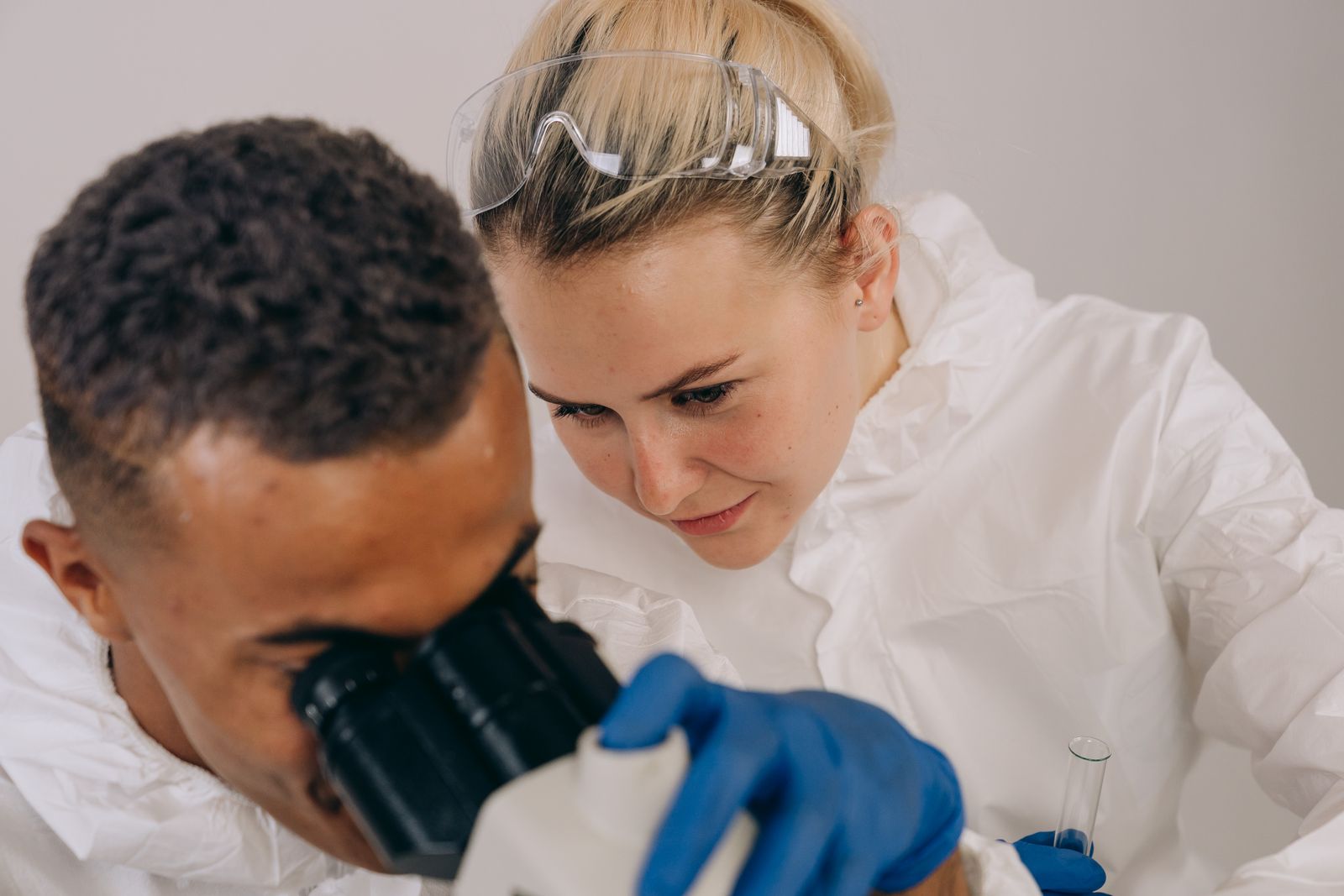
The barium that should not have been there
Hahn and Strassmann were not looking for fission. In 1938 the fashionable question in nuclear physics was whether firing neutrons at uranium, the heaviest element then known, would produce heavier ones — so-called transuranics. Enrico Fermi in Rome had claimed something like it in 1934. Groups in Paris, Berlin and Cambridge were chasing the same idea.
What Hahn and Strassmann kept finding instead was a mess of lighter elements. The most stubborn was a substance that behaved chemically exactly like barium, element 56, with an atomic weight of about 137. Uranium sits at 92, weight 238. The arithmetic was absurd. Hahn, a careful radiochemist who had spent three decades separating vanishingly small quantities of one element from another, trusted his chemistry more than he trusted the physics that said this could not happen. In late December 1938 he and Strassmann sent their paper to Die Naturwissenschaften, reporting the barium and refusing to explain it. The paper appeared in early January 1939.
Strassmann’s role in that chemistry was decisive and, for decades, under-credited. As Chemistry World has argued in a reappraisal of his career, it was Strassmann’s analytical technique — repeatedly co-precipitating the mystery product with barium salts and finding it inseparable — that closed the case. He was also the youngest member of the group, blacklisted by the German Chemical Society for refusing to join Nazi organisations, and living on Hahn’s laboratory budget because no industrial employer would take him.
The letter that crossed the border
Meitner had run the physics side of the Berlin uranium work for years. She was Austrian, Jewish and, until the Anschluss of March 1938, technically protected by her foreign citizenship. When Austria was absorbed into the Reich she became a German citizen overnight, and therefore subject to the racial laws. In July 1938 friends smuggled her across the Dutch border with ten marks in her purse and a diamond ring Hahn had inherited from his mother, in case she needed to bribe a guard. She ended up in Stockholm, at Manne Siegbahn’s institute, without her instruments, without her team and, in the account preserved by The Wire Science’s profile of her exile, without much of a welcome from her new colleagues.
Hahn’s letter reached her in Kungälv, a small town outside Gothenburg, where she was spending Christmas with Swedish friends. Her nephew Otto Frisch, then a physicist at Niels Bohr’s institute in Copenhagen, had come to join her. Frisch later described the scene: Meitner reading Hahn’s letter over breakfast, Frisch skeptical, the two of them going out into the snow to argue about it. Frisch had brought skis. Meitner walked alongside him. They stopped at a fallen tree.

A liquid drop, splitting in the snow
The physics they worked out on that log was, in outline, this. George Gamow and Niels Bohr had proposed a few years earlier that a heavy nucleus behaves less like a rigid ball of particles and more like a droplet of incompressible liquid, held together by short-range nuclear forces the way surface tension holds a raindrop. A uranium nucleus contains 92 protons, all positively charged, all repelling each other. In a stable nucleus the strong force wins. But add one more neutron, and the droplet begins to wobble. Stretch it into a dumbbell shape and the two lobes start pushing each other apart electrostatically faster than the nuclear force can pull them back. At some critical elongation the droplet pinches in the middle and snaps.
Meitner did the energy accounting on the back of Hahn’s letter. She knew, from Francis Aston’s mass spectrograph measurements of the 1920s, that a barium nucleus plus a krypton nucleus weighs slightly less than a uranium nucleus. The missing mass, by Einstein’s E = mc², would be released as kinetic energy. She calculated about 200 million electron volts per split — roughly 50 million times the energy of burning one carbon atom. That energy would push the two fragments apart at roughly one thirtieth the speed of light.
Frisch went back to Copenhagen and caught Bohr just as he was boarding a boat for the United States. According to Frisch’s memoir, Bohr immediately recognized the significance of the discovery and expressed dismay that the scientific community hadn’t seen it sooner. Frisch then ran the confirming experiment: he put a uranium-coated foil next to an ionisation chamber, exposed it to neutrons, and watched pulses far larger than any radioactive decay could produce. The fragments were slamming into the chamber wall with the energy Meitner had predicted.
Borrowing a word from biology
Frisch needed a name. He asked William Arnold, an American biologist working in Bohr’s lab, what biologists called it when a single cell divided into two. Arnold said binary fission. Frisch dropped the adjective. In the paper he and Meitner sent to Nature on 16 January 1939, the word appeared in print for the first time in a nuclear context.
The name mattered. Physicists had been trying to describe the process as some kind of exotic radioactive decay, a chip flaking off. Meitner and Frisch’s framing — that a heavy nucleus could divide itself in half like an amoeba — reorganised the whole picture in one syllable. Within weeks, labs from Paris to New York had repeated the experiment. By late January, Fermi and Leo Szilard in New York were sketching the possibility of a chain reaction: if each split released not only energy but also a couple of spare neutrons, those neutrons could split further nuclei, and the whole thing could run away.
Four years later, under the abandoned squash court beneath Chicago’s Stagg Field, Fermi’s team demonstrated that the chain reaction did indeed run away, and could be stopped. The pile was, in a direct engineering sense, Meitner’s snowy-walk calculation scaled up by fourteen orders of magnitude.
The Nobel that never came
Otto Hahn was awarded the 1944 Nobel Prize in Chemistry, alone, for the discovery of fission. He was in British custody at Farm Hall in Godmanchester when he heard the news over the radio in January 1946, along with nine other captured German nuclear scientists whose conversations the British were secretly recording. Meitner was not on the citation. Strassmann was not on the citation.
The Nobel committee’s records, opened after fifty years, show that the physics committee treated fission as a chemistry problem and the chemistry committee treated Meitner’s contribution as auxiliary. She had been nominated 49 times across physics and chemistry between 1924 and 1965, as Business Insider documented in a survey of the archive, and won none of them. Hahn, for his part, spent the rest of his life insisting in public that fission was a chemical discovery — an argument that got harder to sustain as the physics of it went on to reshape the century.
Element 109, synthesised in Darmstadt in 1982, was named meitnerium in 1997. It is one of only two elements named after a specific, non-mythological woman. The other is curium.
What Meitner refused
In the summer of 1943, the British physicist James Chadwick asked Meitner to join the Manhattan Project. She said no. According to historical records of her wartime stance, Meitner firmly refused any involvement in bomb development and spent the war working on peaceful applications of fission physics in Stockholm. She spent the war in Stockholm, working on the physics of fission products for peaceful applications and writing letters to Hahn accusing him, gently and repeatedly, of moral cowardice for staying in Germany and continuing to work under the regime.
After Hiroshima she was invited onto American radio to be introduced as the “mother of the atomic bomb”. She refused the title. She had done the theoretical calculation that made the weapon conceivable; she had also refused every opportunity to help build one. Both facts belong in the same paragraph.
The German bomb that never was
Hahn’s own group, and the wider German uranium project run by Werner Heisenberg, never came close to a weapon. They failed to appreciate that a bomb needed fast neutrons, not slow ones; they miscalculated the critical mass by a factor of about a hundred; they spent much of the war chasing a heavy-water reactor that never went critical. Sites investigated after the war, including tunnels near St Georgen an der Gusen in Austria that War History Online has catalogued in its survey of Nazi nuclear infrastructure, turned out to be testbeds and enrichment facilities rather than functioning weapons plants. Hahn, listening to the BBC announcement of Hiroshima at Farm Hall on 6 August 1945, told his fellow detainees he felt personally responsible for the deaths of hundreds of thousands of people. Guards had to hide his shoelaces.
What the snowy walk started
Every nuclear reactor operating today — the roughly 440 civil power reactors, the naval propulsion plants, the research reactors, the medical isotope producers — traces its physics to a pencil calculation on a Swedish log in December 1938. The energy release Meitner worked out that morning is why a fuel pellet the size of a fingertip holds the energy of a tonne of coal. The neutron economy Frisch confirmed in his ionisation chamber is what CANDU designers exploit when they run reactors on unenriched uranium, using heavy water as the moderator. The breeding cycles that let a thorium-fuelled core outproduce its own fissile inventory — as demonstrated at Shippingport in the 1970s — are downstream of the same droplet model.
Meitner died in Cambridge in October 1968, three months short of her 90th birthday and eleven days after Hahn. Her nephew Otto Frisch, by then a professor at Cambridge, wrote the inscription for her gravestone in the village of Bramley, Hampshire. It reads: Lise Meitner: a physicist who never lost her humanity.
The log in the Swedish forest is gone. The letter Hahn wrote survives in the archive of the Deutsches Museum in Munich, in an envelope postmarked Berlin-Dahlem, 19 December 1938. The barium was there. The physics was in the snow.