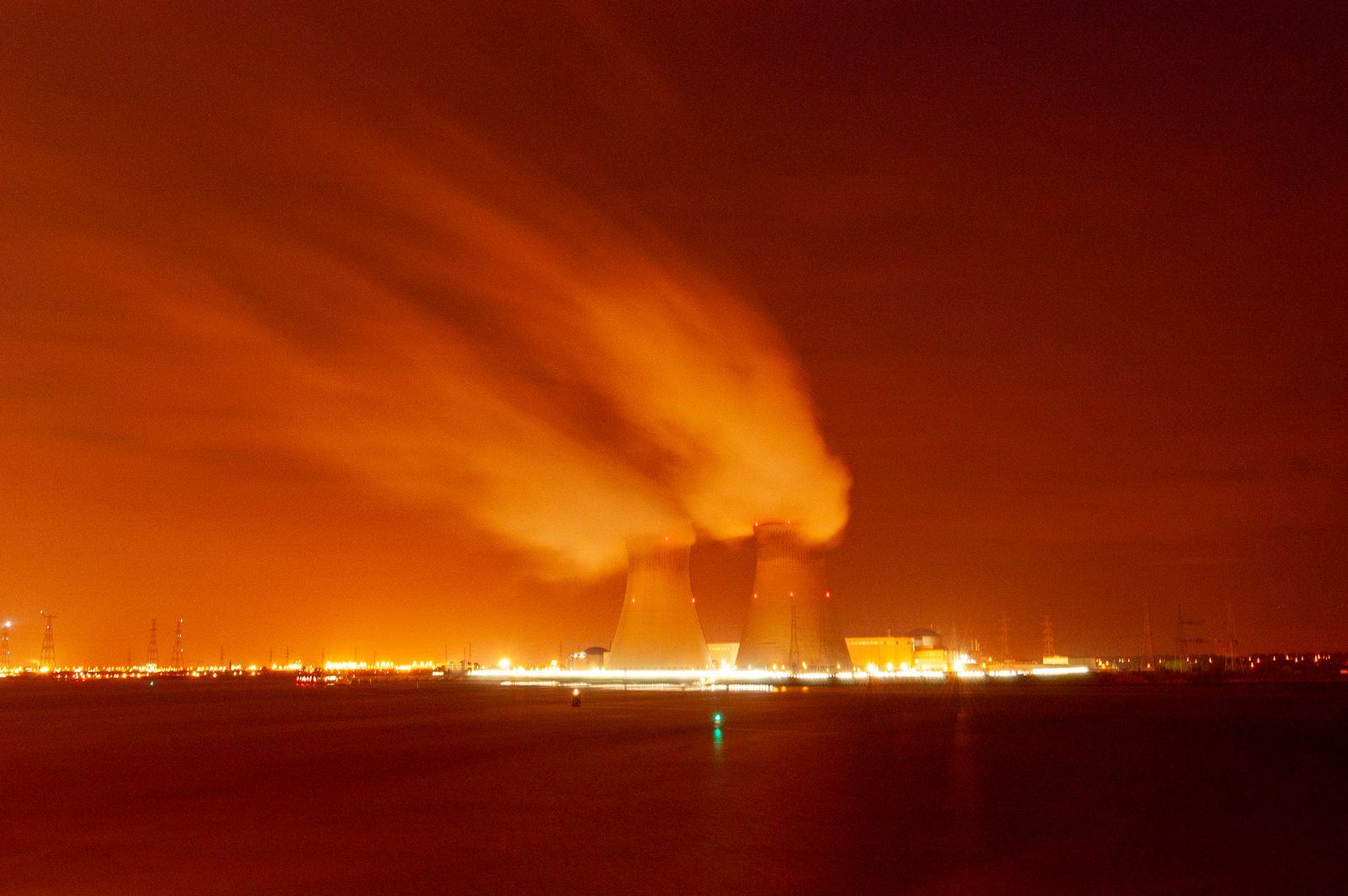
Just before midnight on July 17, 1955, an electrician named Charles Pieper flipped a circuit breaker on the Idaho desert and pushed electricity from an experimental boiling-water reactor called BORAX-III into the streetlamps, kitchens and radios of Arco, Idaho. For about an hour, every watt the town drew came from uranium fissioning in a small pool of water twenty miles out in the sagebrush. Most of Arco’s residents were asleep. They had become, by all available accounts, the first community anywhere on Earth wired end-to-end by splitting atoms.
Years later, sitting in his Arco living room surrounded by yellowed newsclippings, Pieper told a reporter he had barely registered what had happened. I don’t think I grasped the significance of it all, he said. According to historical accounts, Pieper later recalled being too exhausted at the time to fully grasp the significance of the moment.
A town chosen because nothing else was there
Arco sits on the northern edge of the Snake River Plain, in the rain shadow of the Lost River Range. It had a population of about a thousand, a single main street, and the good fortune — or misfortune, depending on your view — of being the nearest inhabited place to the National Reactor Testing Station.
The Atomic Energy Commission had chosen the site for exactly the reason you would guess. It was empty. The scientists could build prototype reactors far from any city, and if something went badly wrong, there was almost nothing downwind for hundreds of square miles of lava rock and sagebrush. Over the coming decades, dozens of reactors would be built on a footprint nearly the size of Rhode Island, including the prototypes that would eventually power the U.S. Navy’s submarine fleet.
BORAX-III was the third in a series of Boiling Water Reactor Experiments run by Argonne National Laboratory. The earlier BORAX tests were designed, in part, to see what happened when a reactor was deliberately pushed past its limits. BORAX-I was destroyed on purpose in the 1950s to study a runaway power excursion. BORAX-III was the tamer sibling — a small, boiling water reactor meant to demonstrate that steam raised directly in the reactor core could turn a turbine and make electricity.
What actually happened on the night of July 17
The physics were straightforward. Water flowed through the BORAX-III core, uranium fuel fissioned, the water boiled, and the resulting steam spun a turbine coupled to a generator. Cool the exhaust steam, pump the water back, repeat.
What made the Arco demonstration a first was not the reactor itself but the wires. Argonne engineers ran a temporary transmission line from the test station to the town’s grid. At around 11 p.m., with the turbine spinning and the reactor stable at power, Pieper opened the breaker that isolated Arco from its usual diesel and hydroelectric feeds. He then closed the breaker connecting the town to BORAX-III.
For roughly an hour — the exact duration varies in historical accounts, with estimates ranging from about an hour to 90 minutes — Arco ran on atoms. Streetlamps, refrigerators, the porch light of anyone who had forgotten to turn it off. A single small reactor on the desert floor was carrying an entire American town.
Then the engineers cut the line, put Arco back on its regular power, and everyone went home. The town’s population never really woke up for it. Arco earned a new nickname — the Atomic City — and a welcome sign that still stands today. The first city in the world lighted by atomic power, it reads.
Why the output was a big deal in 1955
The power BORAX-III delivered is not much by modern standards. A single wind turbine in a Texas field puts out more. A large modern nuclear reactor generates hundreds of times what BORAX-III managed on its best night.
But scale was not the point. The point was that fission could be pointed at something ordinary. Until Arco, nuclear energy in the public mind meant weapons. It meant Hiroshima, Nagasaki, and the mushroom clouds photographed above Bikini Atoll. The first commercial nuclear power plants were still years away — Calder Hall in England opened in the mid-1950s, followed by Shippingport in Pennsylvania. Arco was the proof of concept that came before the concept was fully commercial.
Compare it to what came before. Thomas Edison’s Pearl Street Station in Manhattan lit up a few blocks of lower New York in 1882 from a fuel source far less energy-dense than the uranium BORAX-III used.
A footnote about the “fast breeder” label
BORAX-III is sometimes described as a fast breeder reactor. It was not. It was a boiling water reactor — a thermal-spectrum design, cooled and moderated by ordinary light water. The confusion comes from geography. The nearby EBR-I, the Experimental Breeder Reactor, sits on the same desert and had, in the early 1950s, become the first reactor anywhere to generate electricity, lighting bulbs strung across its turbine hall. EBR-I is now a museum and one of the few places on the Idaho National Laboratory footprint the public can visit without a background check.
So the desert around Arco produced two firsts within a few years of each other — the first electricity from fission (EBR-I) and the first town fully powered by fission (BORAX-III, 1955). Different reactors, different physics, same stretch of sagebrush.
The nuclear ancestor deeper in the ground
The idea of a reactor running in a natural setting was, of course, not new to the universe. Nuclear Power Daily has previously reported on the Oklo uranium deposit in Gabon, where a natural fission reactor ran billions of years ago, long before anything on Earth had a cell nucleus. What Arco did was human. Oklo did it first, without engineers, without a breaker to flip.
The engineers who did the flipping
The BORAX experiments were run out of Argonne National Laboratory, then operating a satellite site in Idaho known as Argonne-West. The boiling water reactor design demonstrated a key safety feature — as the water boiled and the steam bubbles formed, the moderator became less effective and the reaction slowed itself down. That negative void coefficient is now standard in Western BWR design.
Charles Pieper, the electrician who threw the switch, was not a physicist. He was a local hire, one of the many Arco-area residents who worked at the test station and could not tell their families what they did. Clay Condit, a Navy reactor physicist who later settled in Arco, remembered the era vividly. I couldn’t tell my kids what I did, he said in 2005.
What Arco has and hasn’t become
Decades later, Arco remains a small town. The welcome sign is still there. The scientists at what is now the Idaho National Laboratory are still building experimental reactors on the desert, though the goals have shifted from Cold War prestige to climate math.
The lab is working on small-scale reactor designs, compact enough to fit inside shipping containers. Jess Gehin, INL’s associate laboratory director for Nuclear Science and Technology, described the design philosophy in an interview with Courthouse News: They are fully factory-fabricated. You can transport [a microreactor] on a truck or train, [it] can be installed instead of being constructed, and when you’re done with it, it can be taken away. If these designs deliver, small towns like Arco could once again be the natural customer — communities too remote or too small for a full gigawatt plant.
Whether that future arrives is a cost question, not a physics one. Nuclear generation currently costs significantly more per kilowatt-hour than wind or solar, and the gap has been widening. Adrian Gallo, climate program manager at the Idaho Conservation League, has noted in interviews that nuclear power faces significant cost challenges compared to wind and solar energy.
Small reactors, small towns
The BORAX-III moment matters again because the design philosophy it represented — small, sited near the community it serves, plugged directly into a local grid — is being revived in the small modular reactor push. Researchers writing in The Conversation have argued that the SMR future will succeed or fail on whether host communities are consulted early and honestly, not after the concrete is poured.
Some of that vision is already breaking ground. In Oak Ridge, Tennessee, an Amazon-linked fuel company called TRISO-X is planning a fuel-fabrication facility expected to bring around 1,000 jobs, aimed at the pebble and particle fuels that microreactors will need. Elsewhere, startups like TerraPower are pushing regulators to move faster than some in the industry are comfortable with. And in Washington state, Helion Energy has become the first company in the world granted the regulatory licenses it needs to operate a fusion power plant, with a signed deal to deliver 50 megawatts to Microsoft by 2028.
None of these projects are Arco. None of them will light a town of a thousand people for an hour on a July night and then quietly disconnect. But the ancestor of all of them is that breaker Charles Pieper closed in 1955.
The sign is still there
Drive north from Idaho Falls today, past the sagebrush and the lava rock and the low horizon, and you will pass the exit for the Experimental Breeder Reactor, still open as a museum. Keep going. Arco appears about twenty miles further on, tucked against the foot of the mountains. The welcome sign uses the same wording it has used for decades. The claim is specific and, as far as anyone has documented, still true.
The town went dark that night when the engineers cut the line at the test station, and the lamps clicked back over to their diesel and hydro feeds. For about an hour, though, in a place almost nobody was awake to see, the light in every window in Arco came from uranium.