
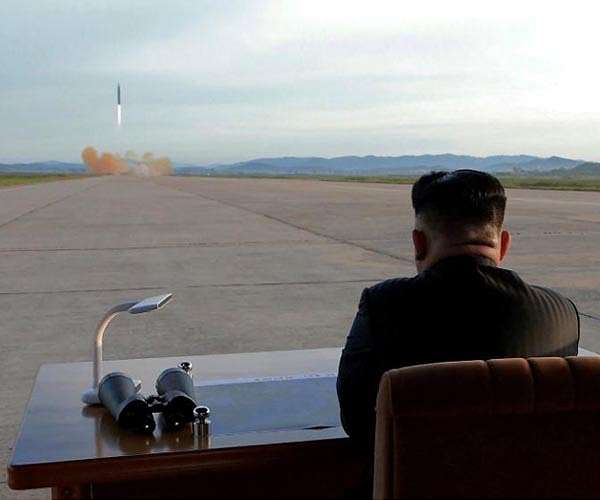
North Korean leader Kim Jong Un inspected the space centre in Pyongyang and praised scientists who recently tested a "reconnaissance satellite", which analysts have warned was a thinly-disguised ballistic missile launch, state media reported Thursday.
North Korean state media claimed "another important test" towards the development of a reconnaissance satellite had been carried out the week before.
Neighbouring South Korea described it as another ballistic missile launch.
Kim "expressed his great satisfaction over the fact that they confirmed the aerospace photographing method, the operating characteristics of high-resolution photographing equipment and the reliability of image transmission system through the recent important tests," state-run KCNA news agency reported.
He "highly appreciated the successes the NADA (National Aerospace Development Administration) has recently made", KCNA continued.
Development of the "reconnaissance satellite" is part of the strategy for monitoring Washington's "aggression troops… and its vassal forces in and around the Korean Peninsula," Kim said, according to KCNA.
North Korea is under biting international sanctions for its nuclear weapons programmes, but peaceful satellite launches are not subject to the same level of restrictions — although they use much of the same technology.
The development of a military reconnaissance satellite — along with a string of banned weaponry, including hypersonic missiles, tested in January — is officially one of Pyongyang's key defence projects, as outlined by Kim last year.
Pyongyang has doubled down on Kim's drive to modernise its military as it ignores US offers of talks and threatens to abandon a self-imposed moratorium on testing long-range missiles and nuclear weapons.
US fails to get China to back UN text against NKorea
United Nations, United States (AFP) March 7, 2022 –
The United States and European allies on the United Nations Security Council failed Monday to convince China and Russia to back a text noting North Korea's "violations" of resolutions on missile technology.
North Korean state media said Pyongyang carried out a test Saturday for what it said was a reconnaissance satellite, but which analysts said was a thinly veiled ballistic missile launch, just days before a presidential election in South Korea.
"We would love to have China and Russia join us in this room" to adopt the text, US Ambassador to the UN Linda Thomas-Greenfield told AFP after a closed-door Security Council meeting.
Backed by 10 other ambassadors — including from countries not on the Security Council, such as Australia and Japan — Thomas-Greenfield read out a text affirming that the group is "united today in condemning the DPRK's March 5 (local time) launch of a ballistic missile," referring to North Korea's official name, the Democratic People's Republic of Korea.
"Like the 10 other ballistic missile launches since the beginning of the year, this act by the DPRK violated multiple Security Council resolutions," she said.
"While the DPRK escalates its destabilizing actions, the Security Council continues to remain silent.
"Each ballistic missile launch that results in inaction by the Council erodes the credibility of the UN Security Council itself," Thomas-Greenfield added, without mentioning China or Russia.
The two countries were the only states opposed to the short, "basic" text at Monday's meeting, diplomats said.
The text said the Security Council had met, that there were "violations" of the Council's resolutions and called for dialogue, a diplomat told AFP on the condition of anonymity.
The meeting marks the 17th time China has opposed the adoption of a US- and European-proposed text against North Korea since 2017, when the Security Council unanimously adopted sanctions in an effort to force Pyongyang to halt its nuclear and ballistic missile programs.
"We stand ready to collaborate and determine a mutually agreeable approach with other Council Members to address the DPRK's provocations," Thomas-Greenfield said.
"But let us start with the basic premise that the Council has a responsibility to speak publicly about clear and repeated violations of Security Council resolutions," she added, calling on other members to also condemn "these dangerous and unlawful acts."
Despite biting international sanctions over its nuclear weapons, Pyongyang has ignored US offers of talks since high-profile negotiations between leader Kim Jong Un and then-US president Donald Trump collapsed in 2019, which Thomas-Greenfield pointed out Monday.
Instead of diplomacy, Pyongyang has doubled down on Kim's drive to modernize its military, warning in January that it could abandon a self-imposed moratorium on testing long-range missiles and nuclear weapons.
