
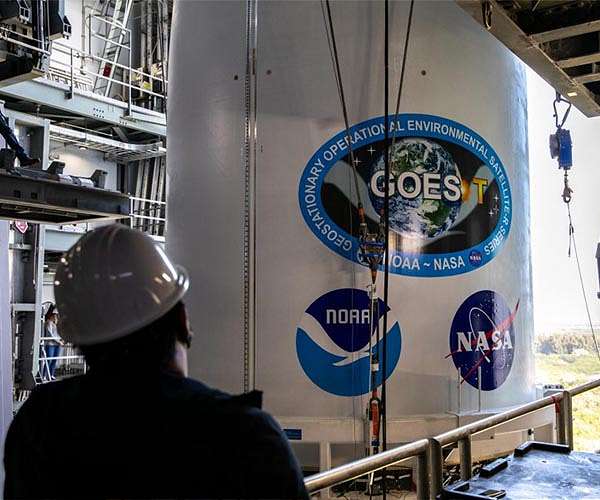
Following a successful Launch Readiness Review at NASA's Kennedy Space Center in Florida, the National Oceanic and Atmospheric Administration's (NOAA) Geostationary Operational Environmental Satellite-T (GOES-T) satellite is cleared to proceed with Tuesday's launch from Cape Canaveral Space Force Station.
Liftoff is targeted for 4:38 p.m. EST on Tuesday, March 1, on a United Launch Alliance Atlas V 541 rocket, from Cape Canaveral Space Force Station's Launch Complex 41. There is a two-hour window for the launch, which is being managed by NASA's Launch Services Program, based at Kennedy.
The current favorable weather forecast for launch day is 60%. The primary concerns are cumulus cloud and surface electric fields.
Coverage of launch day events begins at 4 p.m. Tuesday, March 1. Follow along right here on the blog, or tune in to the live show on NASA TV, the NASA app, or the agency's website.
GOES-T is the third satellite in the Geostationary Operational Environmental Satellites (GOES) – R Series, the Western Hemisphere's most sophisticated weather observing and environmental monitoring system. The GOES-R Series provides advanced imagery and atmospheric measurements, real-time mapping of lightning activity, and space weather monitoring.
After GOES-T launches, it will be renamed GOES-18 once it reaches geostationary orbit. Following a successful on-orbit checkout of its instruments and systems, NOAA plans to put GOES-T immediately into operational service, replacing GOES-17 as GOES West.
