
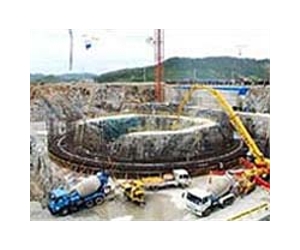
North Korea claims to be building an experimental light-water nuclear reactor for completion by 2012, says a US expert who visited the communist state this month.
Jack Pritchard, president of the Korea Economic Institute, told journalists in Washington Tuesday that he had visited the Yongbyon nuclear complex where the North claims the light-water reactor is being built.
Siegfried Hecker, a US scientist who accompanied Pritchard, has also reported the claims.
While the existing ageing reactor at Yongbyon has supplied plutonium for the North's nuclear weapons, light-water reactors are generally used for generating electricity.
Experts say it is relatively difficult to extract plutonium from them to make atomic weapons.
Some Seoul analysts say the North may be stressing its overall atomic expertise in hopes of prodding the United States into resuming stalled six-nation nuclear disarmament talks.
Pritchard, quoted by South Korea's Yonhap news agency, said he saw "some small modifications to the fuel fabrication centre (at Yongbyon) that they described as part of their new light water reactor programme".
Pritchard, a former US special envoy on North Korea policy who visited the North on November 2-6, also met Kim Kye-Gwan, North Korea's chief nuclear envoy, and other officials.
The reactor is apparently being built slightly in front of where the complex's now-demolished cooling tower was located.
Pritchard said the North wants to complete construction of the reactor that "will only provide enough electricity for the immediate area of Yongbyon… by 2012".
Pyongyang's official policy is to become a "great, powerful and prosperous nation" by that year, the 100th anniversary of the birth of founding president Kim Il-Sung.
"Quite frankly, we are sceptical," said Pritchard.
He said the experimental reactor is one tenth the size of two light-water reactors which were being built under a now-abandoned US-North Korean deal.
Under that 1994 agreement several countries were to build those reactors to generate electricity. In return, the North was to shut down its plutonium-producing operation.
The deal broke down in 2002. The light-water reactors were never completed and the North restarted its original reactor.
The North quit the nuclear disarmament talks in April 2009 and staged a second nuclear test a month later. In recent months it has expressed conditional willingness to return to dialogue.
President Barack Obama warned Thursday in Seoul that North Korea must show "seriousness of purpose" before six-party talks can resume.
Share This Article With Planet Earth
