
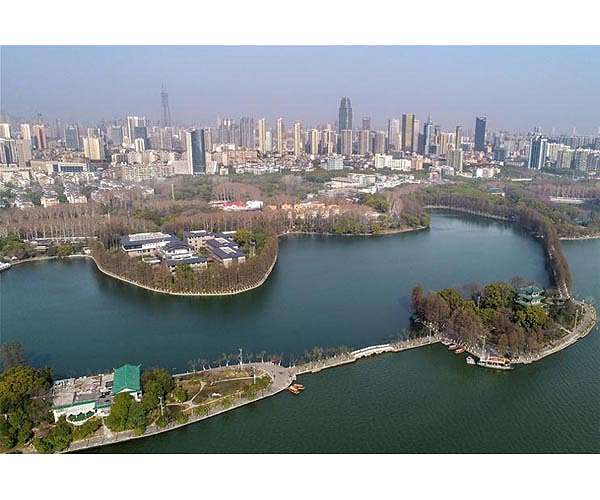
New York on Tuesday announced the introduction of a de facto vaccine pass for some public spaces, as China's Wuhan said it would test all 11 million residents after the coronavirus returned to the place where it first emerged.
Meanwhile, half of the European Union's population has now been fully vaccinated against Covid-19, an AFP tally showed on Tuesday, putting the bloc just ahead of the United States.
The highly contagious Delta variant has driven a surge in infections across the world, including places that had touted their success in overcoming the worst of the pandemic.
New York City will require proof of vaccination for people attending indoor venues such as restaurants, gyms and shows, Mayor Bill de Blasio announced on Tuesday, making it the first major US city to introduce a vaccine pass.
"If you're vaccinated… you have the key, you can open the door. But if you're unvaccinated, unfortunately, you will not be able to participate in many things," de Blasio told a press conference.
With coronavirus cases again surging in the United States, de Blasio said that a health pass called the "Key to NYC" would be launched on August 16, followed by a transition period before enforcement a month later.
"It's time for people to see vaccination as literally necessary to living a good, and full and healthy life," de Blasio said.
– Biggest jab donor –
The US on Monday hit President Joe Biden's goal of administering at least one jab to 70 percent of adults a month late.
Officials blamed falling vaccine rates for the missed deadline as well as the soaring caseload.
"These cases are concentrated in communities with lower vaccination rates," Jeff Zients, White House Covid task force coordinator, told reporters.
In a silver lining, US states that previously lagged behind are belatedly catching up according to the latest vaccination data.
And the US also said it has distributed more than 100 million Covid-19 vaccine doses overseas — more than all other countries combined.
The White House said the announcement marked "just the beginning" of US efforts to help the world battle the pandemic which has claimed more than 4.2 million lives worldwide.
China, which had brought domestic cases down to virtually zero after the coronavirus first emerged in Wuhan in December 2019, has seen that record thrown into jeopardy by Delta.
The fast-spreading variant has reached dozens of cities after infections among airport cleaners in Nanjing sparked a chain of cases that have been reported across the country.
– Testing times –
After Wuhan reported its first local infections in more than a year, authorities said they were launching a mass-testing program for all 11 million residents.
Mao, a 27-year-old Wuhan resident, told AFP he was "not worried" about the new outbreak because "Wuhan has accumulated rich experience" after a gruelling lockdown early on in the pandemic.
Across China, authorities have confined millions of residents of entire cities to their homes, cut domestic transport links and rolled out mass testing in recent days.
And elsewhere, Morocco and France were among countries that announced tighter restrictions in the face of the Covid resurgence.
Morocco increased its curfew hours and stepped up travel restrictions to Agadir, Casablanca and Marrakesh in a bid to slow surging coronavirus cases.
In France, Brittany's Finistere area on Monday ordered people to cover their mouths and noses outdoors after authorities said cases had risen over fourfold between June 30 and July 30.
– EU passes US –
Hit hard by earlier waves of the pandemic and struggling initially to mount inoculation drives, the European Union has now fully vaccinated more than 50 percent of its population.
Spain leads the pack of larger EU countries with 58.3 percent of its population fully vaccinated, followed by Italy with 54.4 percent, France with 52.9 and Germany with 52.2 percent, according to an AFP tally.
The EU has now passed the vaccination rate of the United States — which remains on 49.7 percent.
In Australia, where only 15 percent of the 25-million population are fully vaccinated, authorities are relying on lockdowns to stop a Delta outbreak that has seen 3,600 cases recorded since mid-June.
Millions are still under movement restrictions in the country, and troops on Monday hit the streets of Sydney and surrounding areas, which are entering the sixth week of a lockdown set to run until the end of August.
Australian airline Qantas said it would send home 2,500 workers without pay from mid-August for two months, as the lockdowns kill demand for flights.
Macau orders citywide Covid testing after first cases in 16 months
Hong Kong (AFP) Aug 4, 2021 –
Macau ordered compulsory coronavirus testing for all residents on Wednesday after a family of four was found to be carrying the Delta variant, breaking the city's record of over 16 months virus-free.
Over the next three days authorities plan to test all 680,000 residents at 41 testing centres, the government said.
The testing is one of a host of new measures announced after the gambling hub recorded 491 days without a single local infection.
Authorities are investigating whether the daughter of the family contracted the virus on a flight from Zhuhai to Xi'an in mainland China in July, Macau's leader Ho Iat-seng said on Wednesday.
The same flight carried two other infected people from Nanjing, the centre of a Delta-variant outbreak in China that has led to more than 300 new cases across 15 provinces and cities in two weeks.
Long queues formed on Wednesday morning outside testing centres and the city's health app crashed, local media reported.
Macau has adopted mainland China's health app, which rates infection risk, tracks movement and generates test and vaccination records.
"I have to say sorry to all residents," Ho told reporters.
Macau has kept infections low by closing itself off from the rest of the world for much of the pandemic and placing restrictions on arrivals from mainland China.
It has recorded only 60 cases and no deaths.
But the zero-Covid strategy has come with deep economic costs for the only place in China where gambling is allowed.
Macau's casinos account for about 80 percent of government revenue.
The city ordered a shutdown of all casinos for two weeks when the virus was first detected last year, causing a loss of $937 million, according to an estimate by the University of Macau.
Revenues have climbed this year as some of the border restrictions with mainland China were relaxed but they remain well below pre-pandemic levels.
