
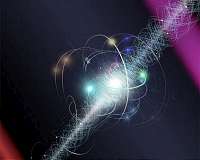
A new study suggests that many theorized heavy particles, if they exist at all, do not have the properties needed to explain the predominance of matter over antimatter in the universe.
If confirmed, the findings would force significant revisions to several prominent theories posed as alternatives to the Standard Model of particle physics, which was developed in the early 1970s. Researchers from Yale, Harvard, and Northwestern University conducted the study, which was published Oct. 17 in the journal Nature.
The discovery is a window into the mind-bending nature of particles, energy, and forces at infinitesimal scales, specifically in the quantum realm, where even a perfect vacuum is not truly empty. Whether that emptiness is located between stars or between molecules, numerous experiments have shown that any vacuum is filled with every type of subatomic particle – and their antimatter counterparts – constantly popping in and out of existence.
One approach to identifying them is to take a closer look at the shape of electrons, which are surrounded by subatomic particles. Researchers examine tiny distortions in the vacuum around electrons as a way to characterize the particles.
The new study reports work done with the Advanced Cold Molecule Electron Dipole Moment (ACME) experiment, a collaborative effort to detect the electric dipole moment (EDM) of the electron. An electron EDM corresponds to a small bulge on one end of the electron, and a dent on the opposite end.
The Standard Model predicts an extremely small electron EDM, but there are a number of cosmological questions – such as the preponderance of matter over antimatter in the aftermath of the Big Bang – that have pointed scientists in the direction of heavier particles, outside the parameters of the Standard Model, that would be associated with a much larger electron EDM.
"The Standard Model makes predictions that differ radically from its alternatives and ACME can distinguish those," said David DeMille, who leads the ACME group at Yale. "Our result tells the scientific community that we need to seriously rethink those alternative theories."
Indeed, the Standard Model predicts that particles surrounding an electron will squash its charge ever so slightly, but this effect would only be noticeable at a resolution 1 billion times more precise than ACME observed. However, in models predicting new types of particles – such as supersymmetry and grand unified theories – a deformation in the shape at ACME's level of precision was broadly expected.
"An electron always carries with it a cloud of fleeting particles, distortions in the vacuum around it," said John Gillaspy, program director for atomic, molecular, and optical physics for the National Science Foundation (NSF), which has funded the ACME research for nearly a decade. "The distortions cannot be separated from the particle itself, and their interactions lead to the ultimate shape of the electron's charge."
ACME uses a unique process that involves firing a beam of cold thorium-oxide (ThO) molecules – a million of them per pulse, 50 times per second – into a chamber the size of a large desk.
Within that chamber, lasers orient the molecules and the electrons within, as they soar between two charged glass plates inside a carefully controlled magnetic field. ACME researchers watch for the light the molecules emit when targeted by a carefully tuned set of readout lasers. The light provides information to determine the shape of the electron's charge.
By controlling some three dozen parameters, from the tuning of the lasers to the timing of experimental steps, ACME achieved a 10-fold detection improvement over the previous record holder: ACME's 2014 experiment. The ACME researchers said they expect to reach another 10-fold improvement on precision in future versions of the experiment.
Unprecedented look at electron brings us closer to understanding the universe
Evanston IL (SPX) Oct 18 – The scientific community can relax. The electron is still round. At least for now.
In a new study, researchers at Northwestern, Harvard and Yale universities examined the shape of an electron's charge with unprecedented precision to confirm that it is perfectly spherical. A slightly squashed charge could have indicated unknown, hard-to-detect heavy particles in the electron's presence, a discovery that could have upended the global physics community.
"If we had discovered that the shape wasn't round, that would be the biggest Unprecedented look at electron brings us closer to understanding the universe in physics for the past several decades," said Gerald Gabrielse, who led the research at Northwestern. "But our finding is still just as scientifically significant because it strengthens the Standard Model of particle physics and excludes alternative models."
The study will be published Oct. 18 in the journal Nature. In addition to Gabrielse, the research was led by John Doyle, the Henry B. Silsbee Professor of Physics at Harvard, and David DeMille, professor of physics at Yale. The trio leads the National Science Foundation (NSF)-funded Advanced Cold Molecule Electron (ACME) Electric Dipole Moment Search.
The sub-standard Standard Model
A longstanding theory, the Standard Model of particle physics describes most of the fundamental forces and particles in the universe. The model is a mathematical picture of reality, and no laboratory experiments yet performed have contradicted it.
This lack of contradiction has been puzzling physicists for decades.
"The Standard Model as it stands cannot possibly be right because it cannot predict why the universe exists," said Gabrielse, the Board of Trustees Professor of Physics at Northwestern. "That's a pretty big loophole."
Gabrielse and his ACME colleagues have spent their careers trying to close this loophole by examining the Standard Model's predictions and then trying to confirm them through table-top experiments in the lab.
Attempting to "fix" the Standard Model, many alternative models predict that an electron's seemingly uniform sphere is actually asymmetrically squished. One such model, called the Supersymmetric Model, posits that unknown, heavy subatomic particles influence the electron to alter its perfectly spherical shape – an unproven phenomenon called the "electric dipole moment." These undiscovered, heavier particles could be responsible for some of the universe's most glaring mysteries and could possibly explain why the universe is made from matter instead of antimatter.
"Almost all of the alternative models say the electron charge may well be squished, but we just haven't looked sensitively enough," said Gabrielse, the founding director of Northwestern's new Center for Fundamental Physics. "That's why we decided to look there with a higher precision than ever realized before."
Squashing the alternative theories
The ACME team probed this question by firing a beam of cold thorium-oxide molecules into a chamber the size of a large desk. Researchers then studied the light emitted from the molecules. Twisting light would indicate an electric dipole moment. When the light did not twist, the research team concluded that the electron's shape was, in fact, round, confirming the Standard Model's prediction. No evidence of an electric dipole moment means no evidence of those hypothetical heavier particles. If these particles do exist at all, their properties differ from those predicted by theorists.
"Our result tells the scientific community that we need to seriously rethink some of the alternative theories," DeMille said.
In 2014, the ACME team performed the same measurement with a simpler apparatus. By using improved laser methods and different laser frequencies, the current experiment was an order of magnitude more sensitive than its predecessor.
"If an electron were the size of Earth, we could detect if the Earth's center was off by a distance a million times smaller than a human hair," Gabrielse explained. "That's how sensitive our apparatus is."
Gabrielse, DeMille, Doyle and their teams plan to keep tuning their instrument to make more and more precise measurements. Until researchers find evidence to the contrary, the electron's round shape – and the universe's mysteries – will remain.
"We know the Standard Model is wrong, but we can't seem to find where it's wrong. It's like a huge mystery novel," Gabrielse said. "We should be very careful about making assumptions that we're getting closer to solving the mystery, but I do have considerable hope that we're getting closer at this level of precision."
