
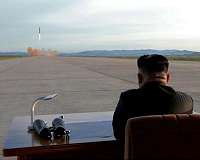
North Korea has surprised analysts with a rapid sequence of missile tests in recent months. International affairs wonks despair that this will disrupt sensitive negotiations with other nations, but so far, the response from the international community (especially Donald Trump) has been fairly muted.
The missile tests certainly do nothing to improve North Korea's international relations, but there are probably more practical reasons for the tests than sabre-rattling.
North Korea has recently developed a new type of short-range ballistic missile with advanced capabilities. It seems to draw much of its heritage from the Russian Iskander missile system. This missile has been used in three separate rounds of testing.
The first came on May 4, when the new missile apparently made its debut. Initial reports suggested a single missile was launched on that day, but a recent South Korean report claims there were two launches.
On May 9, another firing was made with two launches. On July 25, two more of what are believed to be the same missiles were launched on the same day. Less than a week later, on July 31, another two Iskander-style missiles flew in quick succession.
Missile tests do not usually replicate each other precisely, but the variance of ranges of these recent tests is surprising. The longest flight is believed to have gone for around 690 kilometres, while the most recent tests merely went around 250 kilometres.
Other ranges of around 600 and 430 kilometres have also been flown. Sometimes, there are big differences in range when high-altitude "lofted" trajectories are used to fly far vertically with short horizontal ground ranges. But this has not happened with any of these tests. Shorter range tests also reached shorter altitudes, suggesting a conventional ballistic attack trajectory.
The rapid pace of these tests suggests that the missile system is not being debugged for technical purposes. An untamed missile requires a lot of testing followed by long periods of analysis and correction. But the unusual collection of ranges used in these tests should provoke curiosity. To this analyst, it suggests that the new missile is slated for use in some unusual ways.
North Korea's military is grossly inferior to the nations it faces as potential adversaries. The poor state of its troops is well-known. So North Korea has placed a heavy emphasis on asymmetrical weapons and strategies to compensate. The development of nuclear weapons and systems that can take them to America is the most prominent example.
There is nothing new about short-range tactical missile systems like Iskander and its North Korean cousins. But North Korea could be preparing to use tactical missiles with more flexibility than ever before. It is possible that these weapons could have their targets selected and struck with more speed than a traditional missile firing usually requires.
This could allow these missiles to be used against ground targets in motion, such as troop concentrations or vehicle convoys. While blitzkrieg-style ground attacks are potent, they are still slow when compared to aircraft or missiles. So a rough idea of the position of advancing ground forces, coupled with a small tactical nuclear warhead, could be enough to take out a large collection of tanks.
Attacks like this are usually performed by aircraft, and would involve "smart" precision-targeted missiles and bombs. North Korea can't really field traditional air power for this role. So missiles are a potentially useful patch for another hole in North Korean firepower.
The concentration of so many tests in a short period also suggests that North Korea needs to rapidly train new personnel to operate these new weapons. Knowledge of previous missile systems could be of limited use in mastering these new, advanced missiles.
There could be more tests in the near future, possibly to evaluate different ranges and attack plans. But the possibility of new strategies needs to be considered carefully. Many nations field missiles of various types. But a small, strategically challenged nation like North Korea could use them in ways that are outside traditional doctrine.
