
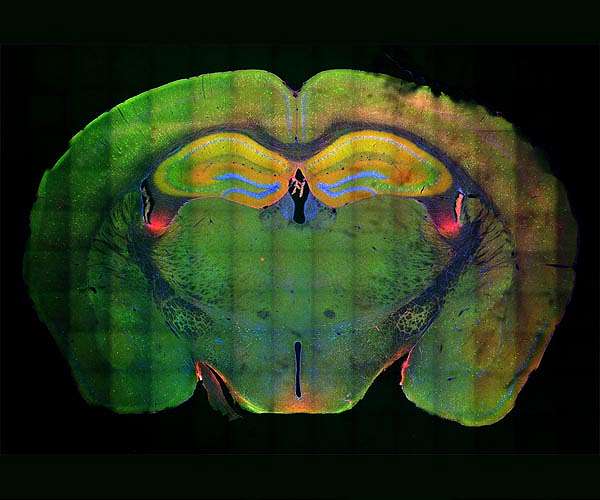
Scientists have managed to extend the depth at which microscopic fluorescence imaging can penetrate and map the interior structures of the brain.
Fluorescence microscopy has previously been used on animal models to yield high-resolution brain images, revealing impressive molecular and cellular details at shallow depths. But the process is quite invasive and limited in scope.
Because light beams are quickly scattered by the skin and skull, fluorescence microscopy is limited in its ability to penetrate and image the brain's interior.
But not all light is equally susceptible to scattering.
To extend the depth of microscopic fluorescence imaging, scientists in Switzerland utilized a distinct spectral window called second near-infrared, which encompasses light wave frequencies ranging from 1,000 to 1,700 nanometers. The use of second near-infrared light, which is less susceptible to scattering, allowed scientists to quadruple the technology's typical depth limit.
Scientists hope their breakthrough, detailed Thursday in the journal Optica, will make it easier to study brain development and disease.
"Visualization of biological dynamics in an unperturbed environment, deep in a living organism, is essential for understanding the complex biology of living organisms and progression of diseases," research team leader Daniel Razansky, professor of biomedical imaging at the University of Zurich and ETH Zurich, said in a news release.
Razansky and his research partners tested their new microscopy method — called diffuse optical localization imaging — on the brain of a mouse model. To begin, scientists intravenously injected the live model with fluorescent microdroplets, yielding a sparse distribution through the mouse's bloodstream.
My measuring the movement of these glowing targets, researchers were able to plot a high-resolution map of the microvasculature woven throughout mouse brain.
"The method eliminates background light scattering and is performed with the scalp and skull intact," said Razansky. "Interestingly, we also observed strong dependence of the spot size recorded by the camera on microdroplet's depth in the brain, which enabled depth-resolved imaging."
The technology's impressive resolution was furthered bolstered by the use of short-wave infrared cameras and high-contrast sulfide-based quantum dots. Both using synthetic brain tissue and live mouse models, scientists were able capture high-resolution images at depths of up to 4 millimeters.
The research team is working on improving their mapping technique and testing other types of microdroplets in an attempt to sharpen the technology's resolution in all three dimensions.
"We expect that DOLI will emerge as a powerful approach for fluorescence imaging of living organisms at previously inaccessible depth and resolution regimes," Razansky said. "This will greatly enhance the in vivo applicability of fluorescence microscopy and tomography techniques."
